Science Themed Crochet Patterns: Ideas, Tips + Free Planet Pattern
Science and crochet have more in common than you’d think. Both require patience, precision, and a genuine love of following instructions. Both reward you with something you can hold in your hands. And both have communities of devoted enthusiasts who will happily talk about their obsession for hours.
So it makes perfect sense that science themed crochet patterns have become one of the most creative, most-gifted, and most-pinned corners of the crochet world right now.
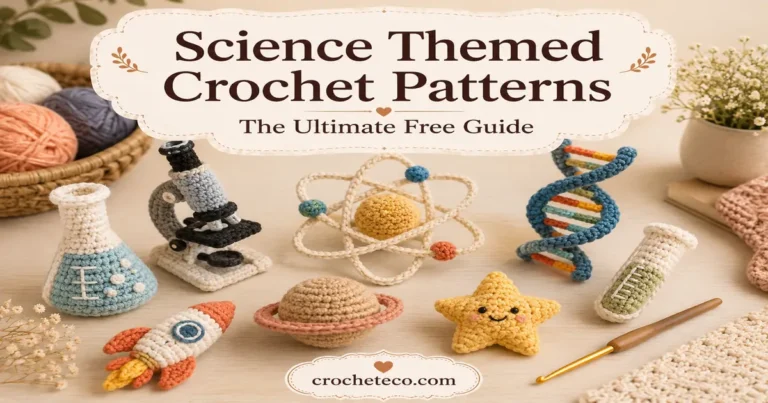
Whether you want to make a crocheted DNA helix for your biology teacher, a plush solar system for a kid who won’t stop asking about planets, or a cuddly amigurumi brain because someone you love is a neuroscience student — this guide covers it all.
From beginner-friendly ideas to full free pattern instructions, here’s everything you need to bring a little science into your crochet basket.
Why Science Themed Crochet Patterns Are Having a Moment
Walk through any craft fair right now and you’ll spot them: tiny crocheted microbes in petri dishes, plush planets lined up on a shelf, anatomical hearts with perfectly placed chambers. Science-themed crochet has moved from niche to genuinely mainstream — and for good reason.
These patterns hit a sweet spot that’s hard to find anywhere else. They’re educational without being boring. They’re funny without being silly. And they make gifts that are completely original in a world where most people already have everything they need.
A crocheted mitochondria plush on a biochemist’s desk? That person will treasure it. A set of amigurumi planets for a child who’s obsessed with space? Instantly their favorite toy. A miniature crocheted flask with a face embroidered on it for a chemistry grad student? They will absolutely show everyone.
The niche also attracts makers who care about quality. Science enthusiasts tend to be detail-oriented, which means science-themed crochet patterns often reward careful work more than almost any other category.
Biology-Themed Crochet Pattern Ideas
Biology gives crochet makers the richest source material of any science field. Everything from the microscopic to the massive has been interpreted in yarn — and the results are genuinely impressive.
Crochet Microbes and Bacteria
These were among the first science-themed crochet projects to go viral, and they’ve never really stopped trending. The basic idea is simple: a small amigurumi plush shaped like a specific bacterium, virus, or cell, often with a cute face embroidered on it.
Popular choices include E. coli (with its distinctive flagella — crocheted in long chain stitches), the coronavirus (a sphere with crocheted spikes — before that became complicated — or better yet, other spherical viruses), and amoeba shapes that let you get creative with irregular, blobby forms.
The appeal is immediate: microbes that cause fear and illness become something soft and oddly charming when they’re the size of your palm and made of cotton yarn. They sell exceptionally well at science department events and make wonderful gifts for medical professionals and biology students.
Crochet DNA Double Helix
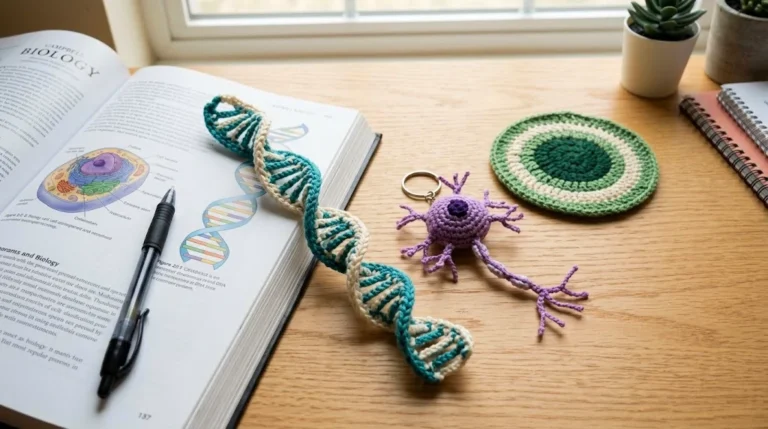
The DNA double helix is one of the most beautiful structures in all of science — and it translates to crochet in a way that’s surprisingly achievable. Most crochet DNA patterns work as a garland or decorative hanging piece, with two spiraling “strands” in different colors connected by “base pair” rungs.
The technique usually involves crocheting two long twisted chains or tubes, then connecting them with short horizontal pieces at regular intervals. The result is instantly recognizable to anyone who’s taken a biology class, and it looks genuinely striking hung on a wall or draped over a shelf.
Amigurumi Brain
A crocheted brain sounds absurd, and that’s exactly why it works so well as a gift. The key to a good amigurumi brain is getting the folded texture right — usually achieved with a combination of long, winding surface crochet ridges or a textured stitch pattern like the crocodile stitch or bobble stitch that mimics the cerebral folds.
Pink is the obvious yarn choice, but a light gray or off-white with pink highlights is actually more realistic — and more interesting to look at.
Anatomical Heart:
Not a cartoon heart — a real, anatomically detailed crocheted heart with chambers, aorta, and veins is a masterpiece-level project for intermediate and advanced makers. It’s also become a beloved Valentine’s Day alternative gift in the science-savvy community. “I’m giving you my heart — anatomically accurately.”
Cell Models:
Plant cells and animal cells make fantastic educational crochet projects, especially for homeschooling families. A crocheted cell model can include individual organelles — mitochondria, nucleus, endoplasmic reticulum — as separate amigurumi pieces arranged inside a larger “cell membrane” container (usually a crocheted pouch or bag). It’s tactile, it’s visual, and children genuinely remember what they learned this way.
Chemistry-Themed Crochet Pattern Ideas
Chemistry gives crochet makers clean geometric shapes to work with — molecules, flasks, beakers — and a ready audience of lab-loving gift recipients.
Molecular Models
Molecule amigurumi patterns are beautifully logical to design. Each atom is a small crocheted sphere, color-coded to match the CPK convention used in real chemistry (carbon = black/dark gray, hydrogen = white, oxygen = red, nitrogen = blue). The atoms connect with short crocheted tubes or thick yarn lengths that represent chemical bonds.
Water (H₂O), caffeine, serotonin, and dopamine are consistently the most popular choices. A crocheted caffeine molecule for a coffee addict? A crocheted serotonin plush for someone who could use a mood lift? These are gifts with genuine wit and warmth behind them.
Crochet Laboratory Glassware
Erlenmeyer flasks, beakers, and round-bottom flasks make wonderful amigurumi characters — their geometric shapes are easy to translate into crochet, and adding a simple face embroidery or safety eyes transforms them into something genuinely endearing.
A crocheted flask with a grumpy face is sold on dozens of Etsy shops. These make wonderful gifts for chemistry teachers, lab technicians, and anyone who’s ever spent long hours waiting for a reaction to complete.
Periodic Table Elements
Square or rectangular crocheted “tiles” with the element symbol, atomic number, and atomic mass embroidered on each one — styled exactly like the periodic table — can be made as individual keychains, coasters, or wall art pieces. Making the whole table is a long-term project, but a set of someone’s “favorite elements” (hydrogen, oxygen, gold) makes a beautiful personalized gift.
Astronomy and Space-Themed Crochet Patterns
Space is arguably the most visually spectacular category of science, and it translates to crochet with a color palette that’s hard to beat: deep indigo, midnight blue, burnt orange, and bright white against a black background.
Crochet Planet Set: Free Pattern Included
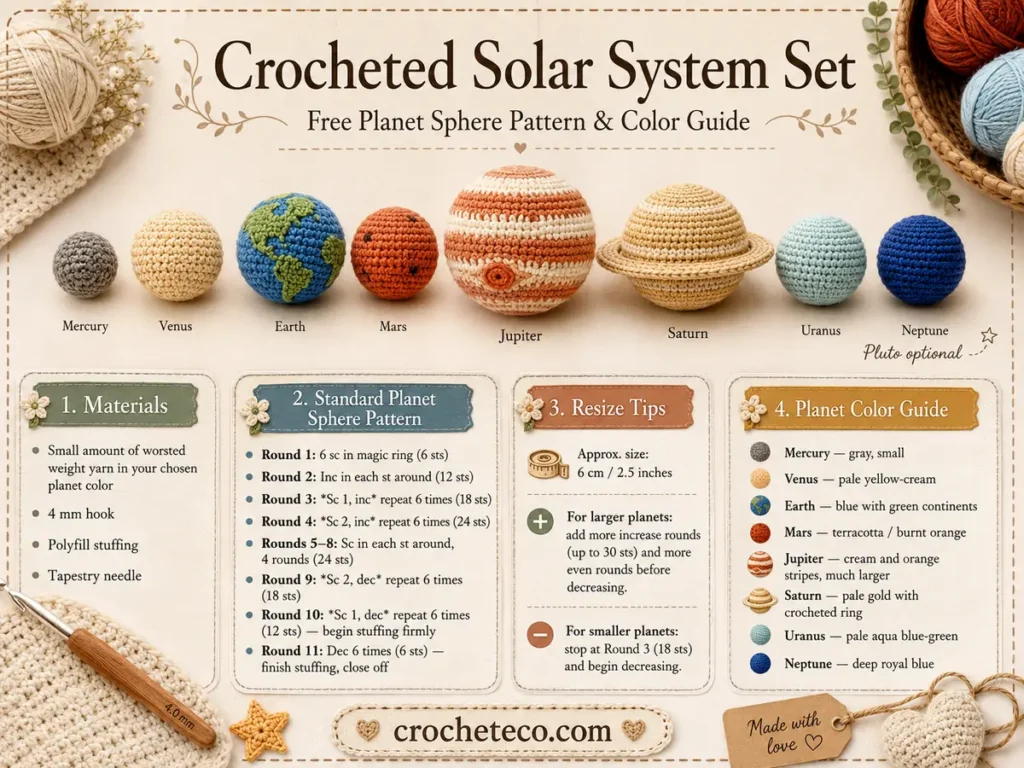
A crocheted solar system set — eight (or nine, depending on your stance on Pluto) planets in accurate relative colors — is one of the most popular science-themed crochet projects for good reason. Each planet is a simple sphere made with standard amigurumi increases and decreases. The variation comes entirely from size, color, and surface texture.
Here’s a free pattern for a standard planet sphere, adaptable to any size:
Materials: Small amount of worsted weight yarn in your chosen planet color, 4mm hook, polyfill stuffing, tapestry needle
Round 1: 6 sc in magic ring (6 sts)
Round 2: Inc in each st around (12 sts)
Round 3: *Sc 1, inc* repeat 6 times (18 sts)
Round 4: *Sc 2, inc* repeat 6 times (24 sts)
Rounds 5–8: Sc in each st around, 4 rounds (24 sts)
Round 9: *Sc 2, dec* repeat 6 times (18 sts)
Round 10: *Sc 1, dec* repeat 6 times (12 sts) — begin stuffing firmly
Round 11: Dec 6 times (6 sts) — finish stuffing, close off
This creates a sphere approximately 6 cm (2.5 inches) in diameter. For larger planets, add more increase rounds (up to Round 5: *sc 3, inc* x6 = 30 sts) and more even rounds before decreasing. For smaller planets, stop at Round 3 (18 sts) and begin decreasing.
Planet color guide (approximate):
- Mercury — gray, small (use Rounds 1–11 as written but with a 3mm hook)
- Venus — pale yellow-cream, similar size to Earth
- Earth — blue base with embroidered or surface-crocheted green continents
- Mars — terracotta or burnt orange, slightly smaller than Earth
- Jupiter — cream and orange stripes, much larger (add 2–3 extra size rounds)
- Saturn — pale gold with a crocheted ring (flat circle sewn around the equator)
- Uranus — pale aqua blue-green
- Neptune — deep royal blue
Crochet Moon
A crocheted moon with crater texture is a beautiful standalone project. The sphere pattern above works perfectly in off-white or pale gray — then add crater texture by working surface crochet circles of different sizes across the finished sphere. Hang it from a length of metallic yarn for a stunning mobile piece.
Constellation Wall Art
Dark yarn worked into a star map shape — using French knots or small bobbles for stars connected by surface-crocheted lines — makes a stunning piece of wall art. Choose a meaningful constellation: the recipient’s birth constellation, a constellation visible from where they live, or simply the most visually dramatic one (Orion never fails).
Physics-Themed Crochet Pattern Ideas
Physics is slightly more abstract than biology or chemistry, which actually opens up interesting creative territory. Some of the most clever science-themed crochet projects are physics-inspired.
Atom Model
A three-dimensional crocheted atom model — nucleus at center, electron orbital rings around it — is a beautiful geometric project. The nucleus is a tight cluster of small spheres (protons in one color, neutrons in another). The orbital rings are crocheted tubes bent into circles and attached at angles around the nucleus. Choose a simple element like hydrogen (one electron, one proton) for a beginner version, or go wild with something like iron or carbon.
Schrödinger’s Cat
Any amigurumi cat pattern can become a Schrödinger’s Cat with the right presentation: put it in a crocheted box where it can be both seen and hidden simultaneously. The concept makes for an endlessly amusing physics-adjacent gift — especially if the recipient has a physics background.
Black Hole Tapestry
The iconic image of a black hole — concentric rings bending toward a dark center — translates beautifully to a circular tapestry crochet pattern. Work from the center outward using shades of orange, yellow, and deep black to recreate the dramatic visual. It looks striking framed or hung as a textile wall piece.
Paleontology and Natural History Crochet Ideas
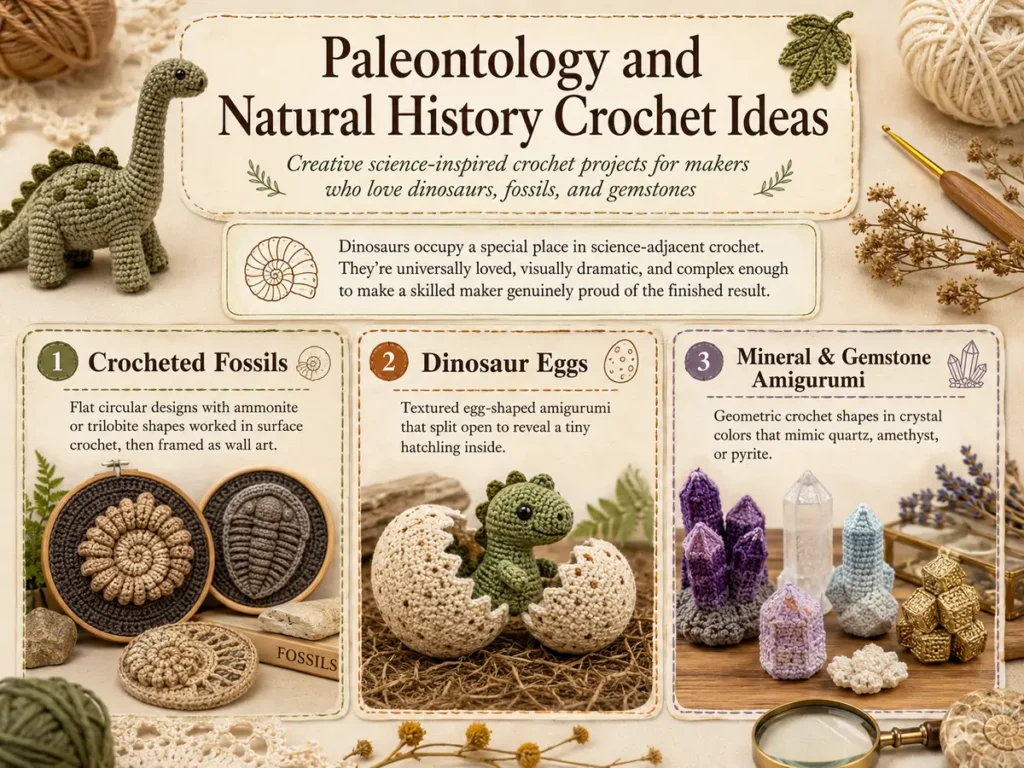
Dinosaurs occupy a special place in science-adjacent crochet. They’re universally loved, visually dramatic, and complex enough to make a skilled maker genuinely proud of the finished result.
Beyond full amigurumi dinosaurs (a category with hundreds of free and paid patterns), consider:
- Crocheted fossils — flat circular designs with ammonite or trilobite shapes worked in surface crochet, framed as wall art
- Dinosaur eggs — textured egg-shaped amigurumi that split open to reveal a tiny hatchling inside
- Mineral and gemstone amigurumi — geometric shapes in crystal colors that mimic quartz, amethyst, or pyrite
Free Crochet Dumbbell Pattern : A fitness fanatic who practically sleeps with their protein shaker? This one’s for you. Free Crochet Dumbbell Pattern : Step-by-Step Amigurumi Tutorial
Science Crochet as Gifts: Who These Are Perfect For
Science-themed crochet projects are among the most universally successful gifts you can make by hand. Here’s who will love them most.
- Science teachers — especially biology, chemistry, and physics teachers who decorate their classrooms with personality
- University students in STEM fields who spend long hours in labs and appreciate something warm and human on their desk
- Medical professionals — doctors, nurses, pharmacists, and researchers who see the humor in anatomical crochet
- Children who love science — a crocheted solar system is more educational than most actual toys
- Science communicators — YouTubers, podcasters, and writers who cover science and love unique branded desk decor
- Science fiction fans — the overlap between sci-fi enthusiasts and science crochet appreciation is very real
Tips for Getting Science Details Right
Science-themed crochet lives or dies on accuracy. A technically correct pattern impresses the target audience; a careless one gets politely corrected. Here are a few ways to make sure your science holds up.
Research Before You Stitch
If you’re making a specific molecule, look up its actual structure before deciding on colors and bond angles. If you’re making a planet, check the actual color palette — Neptune is a deeper blue than Uranus, not interchangeable. These details matter enormously to science enthusiasts.
Use Color Conventionally
For molecular models, the CPK color convention is widely understood: carbon is black or dark gray, hydrogen is white, oxygen is red, nitrogen is blue, sulfur is yellow. Sticking to convention means the recipient will immediately recognize what they’re looking at.
Label When Needed
A small embroidered or felt label — “H₂O”, “C₈H₁₀N₄O₂” (caffeine), or “Fe” — on a molecule or element piece adds instant clarity and a wonderful nerdy charm. It also shows you did the work.
Choose Yarn for Visual Accuracy
Matte cotton yarn reads more scientifically precise than shiny acrylic. For anatomical pieces, slightly matte, natural-toned yarns tend to look more realistic. Save the sparkle yarn for stars, gemstones, and anything intentionally fantastical.
Eco-Friendly Considerations for Science Crochet
Science and environmental awareness go hand in hand — and your yarn choices can reflect that. Choosing sustainable materials for science-themed projects makes them even more aligned with values that many scientists and science enthusiasts hold.
- Organic cotton works beautifully for amigurumi organisms and anatomical pieces where a slightly matte, natural finish is ideal
- Recycled polyester stuffing — made from post-consumer plastic bottles — is widely available and keeps petroleum-based stuffing out of landfills
- Tencel or bamboo yarn brings a beautiful sheen to planet and mineral pieces while remaining a low-impact fiber choice
- Natural dye yarn is particularly meaningful for science pieces — the chemistry of natural dyeing is a science story in itself
Frequently Asked Questions
Are science themed crochet patterns good for beginners?
Many are. Simple planet spheres, basic molecule atoms, and small microbe amigurumi all use beginner-friendly single crochet and basic amigurumi shaping. More detailed pieces — like anatomical hearts or full DNA helices — are better suited to intermediate makers. Most science-themed patterns exist across a wide range of difficulty levels.
Where can I find free science themed crochet patterns?
Ravelry has a large collection of science-themed patterns, many free. Etsy offers both free and paid options. Pinterest is excellent for discovery. And crochet pattern blogs like this one regularly publish original free patterns in niche categories. Searching terms like “amigurumi molecule free pattern,” “crochet planet pattern free,” or “crochet microbe pattern” yields strong results.
What yarn works best for science themed crochet projects?
It depends on the project. For amigurumi pieces (planets, microbes, molecules) a firm cotton or worsted weight acrylic holds its shape best and keeps stitch definition crisp. For wall art and decorative pieces, natural fibers like linen or cotton give a more refined, museum-quality look. Avoid overly fluffy or textured yarn for anything that needs to be visually precise.
Can I sell science themed crochet items I make from free patterns?
This depends entirely on each individual pattern’s licensing. Most independent designers who publish free patterns allow sales of finished items — but always check the pattern’s specific terms. Patterns marked “personal use only” should not be used for commercial items. When in doubt, send the designer a quick message — most are happy to clarify or grant permission.
How difficult is it to make a crochet DNA helix?
A basic decorative DNA helix garland is intermediate level — it requires knowing how to crochet tubes, join colors, and assemble components neatly. A truly accurate double helix with clearly differentiated base pairs and realistic proportions is an advanced project. Many beautiful interpretations sit in between: recognizable as DNA, achievable in an afternoon, and impressive to anyone who receives one.
What’s the most popular science themed crochet project?
Based on search volume, sales data, and Ravelry favorites, amigurumi planet sets consistently top the list — particularly full solar system sets with all eight planets. Crocheted microbes (especially “giant microbes” style plush bacteria) and molecule amigurumi (caffeine and serotonin especially) are also perennially popular. Anatomical hearts trend heavily around Valentine’s Day.
Final Thoughts
Science themed crochet patterns represent something genuinely special in the crafting world: the place where precision meets creativity, where a maker’s skill and a subject’s complexity come together into something you can hold in your hand.
Whether you make a tiny crocheted neuron for a neuroscience student, a full solar system for a child who wants to be an astronaut, or a perfectly proportioned water molecule for someone who keeps reminding you that chemistry is everywhere — these projects land differently than most handmade gifts.
They say: I know what you care about. I made something that speaks your language. And I did it with yarn, a hook, and a lot of patience.
That combination is pretty hard to beat.
Which science themed project are you planning to make first? Drop it in the comments — we’d love to hear what’s on your hook next.
Happy crocheting.

1 thought on “Science Themed Crochet Patterns : The Ultimate Free Guide”