
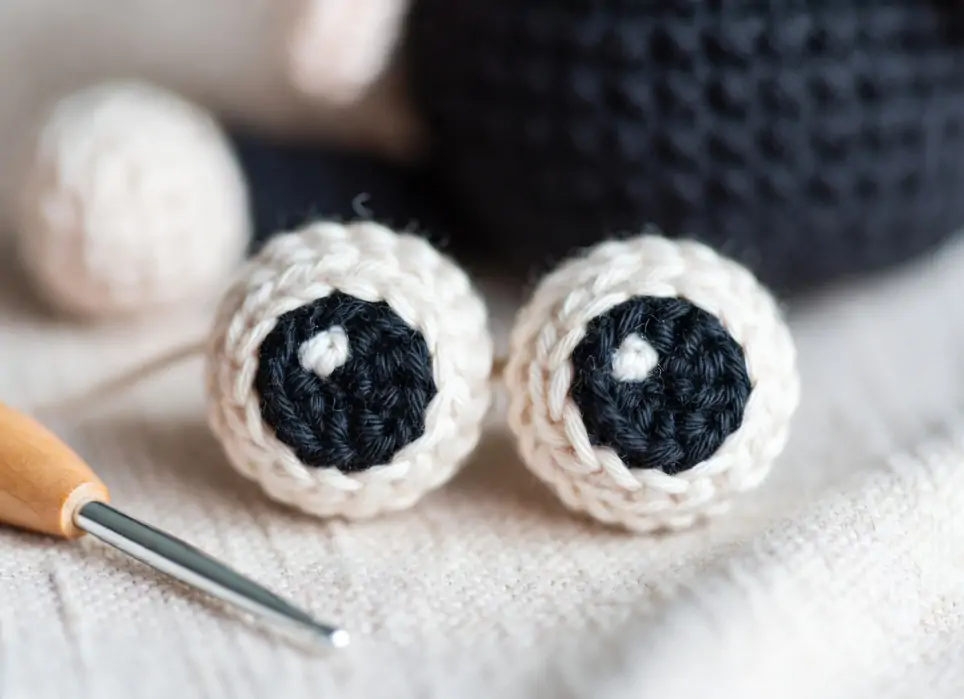
Crocheted eyes are a simple way to give amigurumi a soft, handmade look without relying on plastic safety eyes. This guide shows an easy one-round eye, ways to change the size, how to add a small highlight, and how to sew both eyes on evenly.
What You Need
- Black or dark yarn for the pupil or full eye
- A crochet hook that makes a firm fabric with your yarn
- A yarn needle
- Scissors
- A short piece of white yarn or embroidery floss for an optional highlight
- Stitch markers or pins for testing eye placement
Smooth cotton or a smooth acrylic yarn is easiest to control. Very fuzzy yarn can blur the edge of a tiny eye and make both pieces look slightly different.
Easy One-Round Crochet Eye
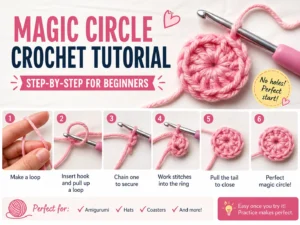
- Make a magic ring. If you are new to this technique, use the magic circle crochet tutorial first.
- Chain 1. The chain does not count as a stitch.
- Work 6 single crochet stitches into the ring.
- Pull the starting tail until the center closes.
- Slip stitch to the first single crochet, or finish with a neat invisible join.
- Leave a sewing tail about 8 to 10 inches long.
Make the second eye with the same yarn, hook, stitch count, and tension. Compare the two pieces before sewing them on. If one is clearly larger, remake it now; tiny differences become much easier to see once the eyes are attached.
Simple Crochet Eye Size Guide
| Look you want | Easy adjustment |
|---|---|
| Very small eye | Use thinner yarn or thread and a smaller hook. |
| Standard small amigurumi eye | Use 6 single crochets in one magic ring. |
| Slightly fuller eye | Try 7 or 8 single crochets with the same yarn. |
| Larger flat eye | Add a second round with evenly spaced increases. |
The exact finished diameter changes with yarn thickness, hook size, and tension. For a matching pair, consistency matters more than chasing an exact millimeter measurement.
How to Make a Larger Two-Round Eye
For an eye that needs more surface area, start with 6 single crochets in a magic ring. In Round 2, work 2 single crochets in each stitch around for 12 stitches. Join and fasten off with a long sewing tail.
If 12 stitches make the eye too large, do not force it to fit. A smaller hook or thinner yarn usually gives a cleaner result than trying to stretch or squash the circle.
Add a Small White Highlight
A tiny white stitch can make a dark crochet eye look brighter. Thread a small amount of white yarn or embroidery floss onto a needle. Make one short stitch near the upper side of the eye and secure the ends on the back.
Keep the highlight in the same position on both eyes. One small stitch is usually enough. Large white areas can change the expression and may make the two eyes harder to match.
How to Position Amigurumi Eyes Evenly
Do not sew the first eye on as soon as you finish it. Place both eyes on the head first and use pins or removable stitch markers to test the position.
- Find the center line of the face.
- Count the stitches from the center to the left eye.
- Place the right eye the same number of stitches from the center.
- Look at the face from the front, top, and side before sewing.
A difference of only one stitch can noticeably change the expression on a small amigurumi head. Counting is more reliable than judging the spacing by eye alone.
How to Sew Crochet Eyes to Amigurumi
- Thread the long tail from the eye onto a yarn needle.
- Hold or pin the eye flat in its chosen position.
- Take small stitches around the outer edge of the crochet circle.
- Pass the needle through the head fabric without pulling hard enough to pucker the face.
- Check the eye after every few stitches to make sure it has not shifted.
- Secure the yarn according to your project instructions and hide the tail inside the stuffed piece.
The goal is a flat edge with no loose loops. If the eye cups outward, loosen the sewing tension slightly. If the face dents inward, you are pulling the attachment stitches too tightly.
Crochet Eyes vs. Plastic Safety Eyes
Crochet eyes create a fully yarn-based look and are easy to customize in size and color. Plastic safety eyes give a smooth, shiny finish and are faster to install during construction. Neither choice replaces responsible finishing and product-safety decisions.
For items intended for babies or small children, avoid loose parts and use construction methods appropriate for the age and intended use of the finished item. Check applicable product-safety requirements if you sell finished toys.
Common Problems and Fixes
The center has a hole
Pull the magic-ring tail firmly before joining. If the yarn is slippery, secure the center on the back before attaching the eye.
One eye is larger
Check the stitch count first. Then compare tension. Tiny circles react strongly to small tension changes, so remaking one eye is often faster than trying to reshape it.
The eye looks wavy
The hook may be too large for the yarn or there may be too many stitches in the round. Try a smaller hook or reduce the stitch count.
The eye disappears into dark yarn
Add a thin lighter outline or a small white highlight. You can also choose a dark brown or charcoal eye instead of pure black when the head yarn is very dark.
The face looks uneven after sewing
Remove the second eye before tying off permanently, recount the spacing from the center line, and reposition it. Small corrections are much easier before the yarn tail is hidden.
Easy Color Ideas
- Classic: black eye with one white highlight.
- Soft animal look: dark brown instead of black.
- Fantasy character: colored outer round with a dark center.
- Sleepy face: skip the circle and embroider a short curved line instead.
Frequently Asked Questions
Can a beginner crochet amigurumi eyes?
Yes. The basic version uses only a magic ring, chain, single crochet, and a join. If those movements are new, practice them first in the beginner crochet guide.
Do both eyes need to be exactly the same size?
They should be close enough that the difference is not visible on the finished face. Use the same yarn, hook, stitch count, and tension for both pieces.
Can I make eyes without a magic ring?
Yes. Chain 2 and work the first-round stitches into the second chain from the hook. The center may be slightly more visible, but it is a useful alternative if you do not like magic rings.
Should I stuff crocheted eyes?
Flat one- or two-round eyes do not need stuffing. Dimensional eyes are a different construction and should follow a pattern designed for that shape.
Final Check Before You Finish
Set the amigurumi upright and look at the face from normal viewing distance. Check that the eyes are level, equally spaced from the center, firmly attached, and free of loose yarn ends. When those details look right, hide the tails and continue with the rest of the face.





Reader discussion
Reader Comments
Tried this pattern? Share what worked, ask a question, or help another crocheter.
Your turn
Comments are moderated to keep the discussion useful and family-friendly. Please do not post personal information.