
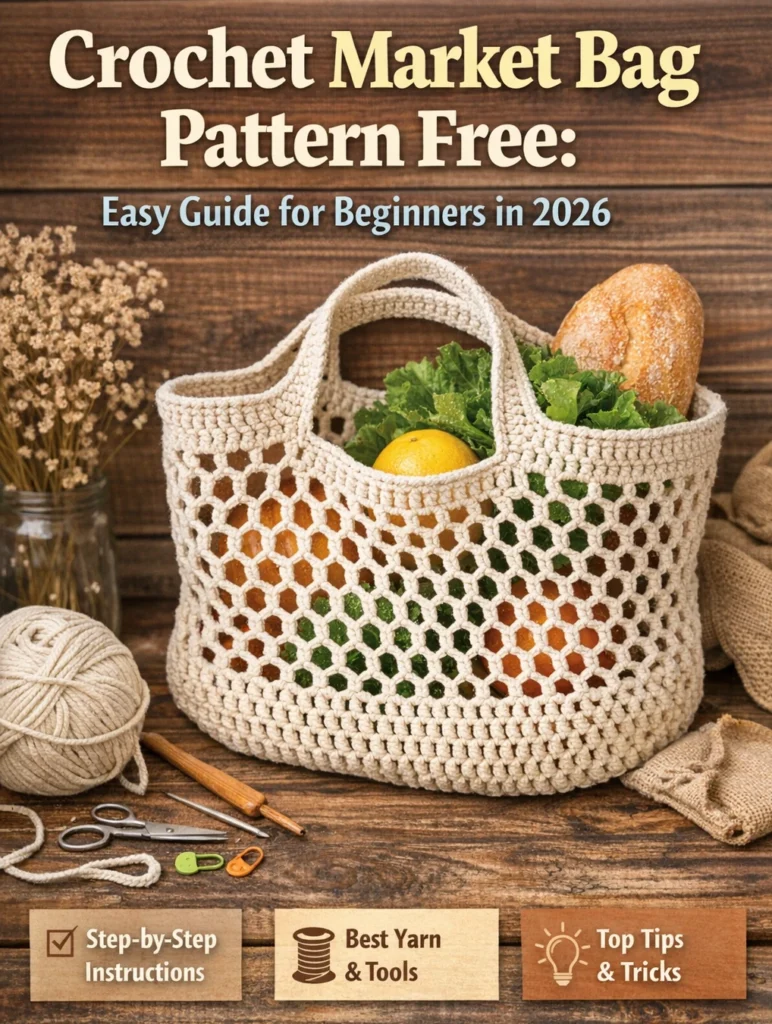
Easy Cotton Mesh Market Bag
A solid oval base, an open mesh body, and two reinforced handles worked from the top edge.
This free crochet market bag pattern starts with a solid single-crochet base, so small items have a firmer place to sit. The body changes to an open chain mesh that expands when the bag is filled. A solid upper band supports two handles worked directly into the final rounds.
What You Will Make
The bag is worked from the bottom up in joined rounds. Five increase rounds form an oval base. One back-loop round makes a fold line, then 96 base stitches become 24 mesh units. After the final mesh round, Round 31 changes the 24 mesh spaces back to 96 single crochet stitches for the top band.
Each handle is centered over one 48-stitch face of the bag. The handle chains are reinforced with three rounds of single crochet. These are hand or forearm handles, not guaranteed shoulder straps.
This mesh bag stretches by design. For a denser tote with a rectangular base and sewn shoulder handles, use the crochet bag pattern for adults.
Finished Size and Gauge
Approximate size
- 14 in. / 35.5 cm wide when laid flat
- 15–16 in. / 38–40.5 cm body height
- Handles suited to hand or forearm carry
- Mesh expands when filled
Gauge target
- 14 sc × 16 rows = 4 in. / 10 cm
- 7 ch-4 spaces = about 8 in. / 20 cm
- 7 mesh rounds = about 4 in. / 10 cm
- Measure the mesh without stretching it
Make a solid single-crochet swatch larger than 4 inches, then wash and dry it as you plan to care for the bag. If you have fewer than 14 stitches across 4 inches, use a smaller hook. If you have more than 14, use a larger hook. The crochet hook size chart can help when changing sizes.
Materials
- 500–600 yd. / 457–549 m of CYC #4 medium-weight cotton or a firm cotton blend
- 5 mm / US H-8 crochet hook, or the size needed to match gauge
- Four locking stitch markers
- Tapestry needle and scissors
- Optional cotton twill tape for extra handle support
The yarn amount is a planning estimate. Yardage varies with tension, yarn, and any changes to the bag or handles. A low-stretch cotton gives the mesh less bounce than a soft acrylic. Check the yarn label for washing instructions and buy enough from one dye lot when possible.
Very small objects can pass through the openings. Place keys, pens, and other narrow items in a pouch, or add a fabric lining. Do not use open mesh for sharp or hot items.
US Crochet Terms and Pattern Notes
| Abbreviation | US term | Use in this pattern |
|---|---|---|
| ch | chain | Foundation, mesh, and handles |
| sc | single crochet | Base, anchors, band, and handles |
| sl st | slip stitch | Joins each round |
| st / sts | stitch / stitches | Stitch counts |
| sp | space | The opening below a chain loop |
| BLO | back loop only | Creates the base fold line |
| rep | repeat | Repeat the bracketed instruction |
- All rounds are joined unless stated otherwise.
- The ch 1 at the beginning of a single-crochet round does not count as a stitch.
- The joining slip stitch does not count as a stitch.
- Place a marker in the first true stitch of each solid round.
- Count mesh spaces, not individual chains, in Rounds 7–30.
If these terms are new, review the beginner crochet guide before starting.
Part 1: Crochet the Solid Oval Base
Work around both sides of the foundation chain. The 28 stitches along each straight side stay unchanged. All increases are placed on the two curved ends.
Base instructions
Part 2: Work the Mesh Body
Each mesh unit consumes four base stitches: one single-crochet anchor plus three skipped stitches. Since 96 divides evenly by four, the round produces 24 matching spaces.
Mesh instructions
Stop at the end of every round and count 24 chain spaces. If you have 23 or 25, undo that round. A missed space changes the upper band and handle placement later.
Part 3: Make the Solid Upper Band
Upper-band instructions
The conversion is exact: 24 mesh spaces × 4 single crochet stitches = 96 stitches. Adding another stitch in each old anchor would create 120 stitches and make the top flare.
Part 4: Center and Reinforce the Handles
Mark the side folds
After Round 34, lay the bag flat with the oval base centered. Place one marker at each side fold. Count 48 stitches across the front and 48 across the back. Use the folds, not the mesh join, to center the handles.
Move the start point
Fasten off after Round 34. Rejoin the yarn in a marked side-fold stitch. Ch 1; it does not count as a stitch.
Create both handle loops
Round 35: Sc in the marked st and the next 13 sts, ch 44, skip the next 20 sts, sc in the next 28 sts, ch 44, skip the next 20 sts, and sc in the last 14 sts. Join to the first sc. 144 elements around the new path.
Reinforce the handles
Rounds 36–38: Ch 1. Sc in every sc and in every chain around. Join to the first sc. 144 sc in each round. Fasten off after Round 38 and weave in the ends.
Pull on both handles by hand and inspect the joins. Cotton mesh stretches under load, and this pattern has no tested weight rating. Add cotton twill tape inside the handles if you want to limit stretching during repeated use.
Stitch Count Checkpoints
| Checkpoint | Required count | Calculation |
|---|---|---|
| Base Round 1 | 64 sc | 2 + 28 + 4 + 28 + 2 |
| Base Rounds 2–5 | 72, 80, 88, 96 | Each round adds 8 stitches |
| Fold Round 6 | 96 sc | No increases in BLO |
| Mesh Rounds 7–30 | 24 spaces | 96 ÷ 4 = 24 units |
| Upper Round 31 | 96 sc | 24 spaces × 4 sc |
| Band Rounds 32–34 | 96 sc | No increase or decrease |
| Handle Round 35 | 144 elements | 56 sc + 88 chains |
| Handle Rounds 36–38 | 144 sc | One sc in each previous element |
How to Adjust the Size
Make the bag taller
Add mesh rounds before Round 31. At the stated gauge, each mesh round adds about 0.57 inch / 1.45 cm while the bag is resting. Keep 24 spaces in every added round.
Make longer handles
In Round 35, replace each ch 44 with ch 56 and keep each skipped section at 20 stitches. The new path contains 168 elements: 56 existing single crochet stitches + 112 handle chains. Rounds 36–38 must therefore contain 168 sc, not 144. Longer handles may stretch more and are not guaranteed to fit every shoulder.
Make the base wider
Add one increase round after Round 5 and before the BLO round:
[2 sc in the next st, sc in the next 4 sts] twice; sc in the next 28 sts; [2 sc in the next st, sc in the next 4 sts] 4 times; sc in the next 28 sts; [2 sc in the next st, sc in the next 4 sts] twice. The result is 104 sc, which becomes 26 mesh units because 104 ÷ 4 = 26. Recalculate the two handle positions rather than copying the original 14/20/14 layout.
Troubleshooting
| Problem | Likely cause | Fix |
|---|---|---|
| The oval base ruffles | Gauge is loose or increases are misplaced | Check each curved-end repeat and try a smaller hook if the count is correct. |
| The base cups | Tension or foundation chain is too tight | Relax the chain or use a larger hook for the foundation only. |
| The mesh leans | The join moves slightly each round | This is normal with joined mesh. Center handles from the side folds, not the join. |
| The mesh count changes | A chain space was skipped or used twice | Mark the first space and count all 24 before joining. |
| The upper band flares | Stitches were added in both spaces and anchors | Round 31 uses 4 sc in each space only: 24 × 4 = 96. |
| One handle is off-center | The two 48-stitch faces were not marked first | Undo Round 35, flatten the bag, and mark both side folds before restarting. |
Finishing, Care, and Reasonable Use
- Weave each tail through several stitches in two directions.
- Wet block gently without pulling the mesh to its maximum size.
- Check the yarn label for care instructions. If the color may bleed, wash a small swatch before washing the bag.
- Follow the yarn label, press out water without wringing, and dry flat.
- Do not hang the wet bag by its handles.
- Check the upper band and handle stitches regularly.
The bag can be reused for ordinary market trips, but no maximum load is stated. Yarn, tension, moisture, and workmanship all change how much the fabric stretches. Do not use it for a child, pet, sharp tools, or hot containers.
Frequently Asked Questions
Why use cotton for a crochet market bag?
A firm cotton or cotton blend usually has less bounce than a soft acrylic, so the bag may keep its shape better. Cotton can still stretch when loaded, especially in an open mesh.
Can I use a different yarn weight?
You can, but the bag size, mesh openings, and yardage will change. Make new solid and mesh swatches, then check that small items cannot fall through the larger openings.
Does this bag need a lining?
No, but a lining helps contain keys and other narrow items. It can also reduce some stretching. Measure the finished bag after blocking before cutting fabric.
Why are the handles worked over 144 stitches?
Round 35 keeps 56 single crochet stitches and adds two 44-chain handles. That creates a new path of 56 + 88 = 144 elements. Each reinforcement round works one single crochet into every element.
Can I work the mesh in a spiral?
Not without rewriting the transition and join instructions. This version uses joined rounds so the 24-space checkpoints remain easy to identify.
Is this the same as the solid adult tote?
No. This bag has an expanding mesh body and integrated handles. The solid adult tote uses dense fabric, a rectangular base, and separately sewn handles.
Confirm 24 mesh spaces, 96 upper-band stitches, and matching handle loops. Tug the handles, check the joins, and secure every yarn tail before carrying the bag.



Reader discussion
Reader Comments
Tried this pattern? Share what worked, ask a question, or help another crocheter.
Your turn
Comments are moderated to keep the discussion useful and family-friendly. Please do not post personal information.