
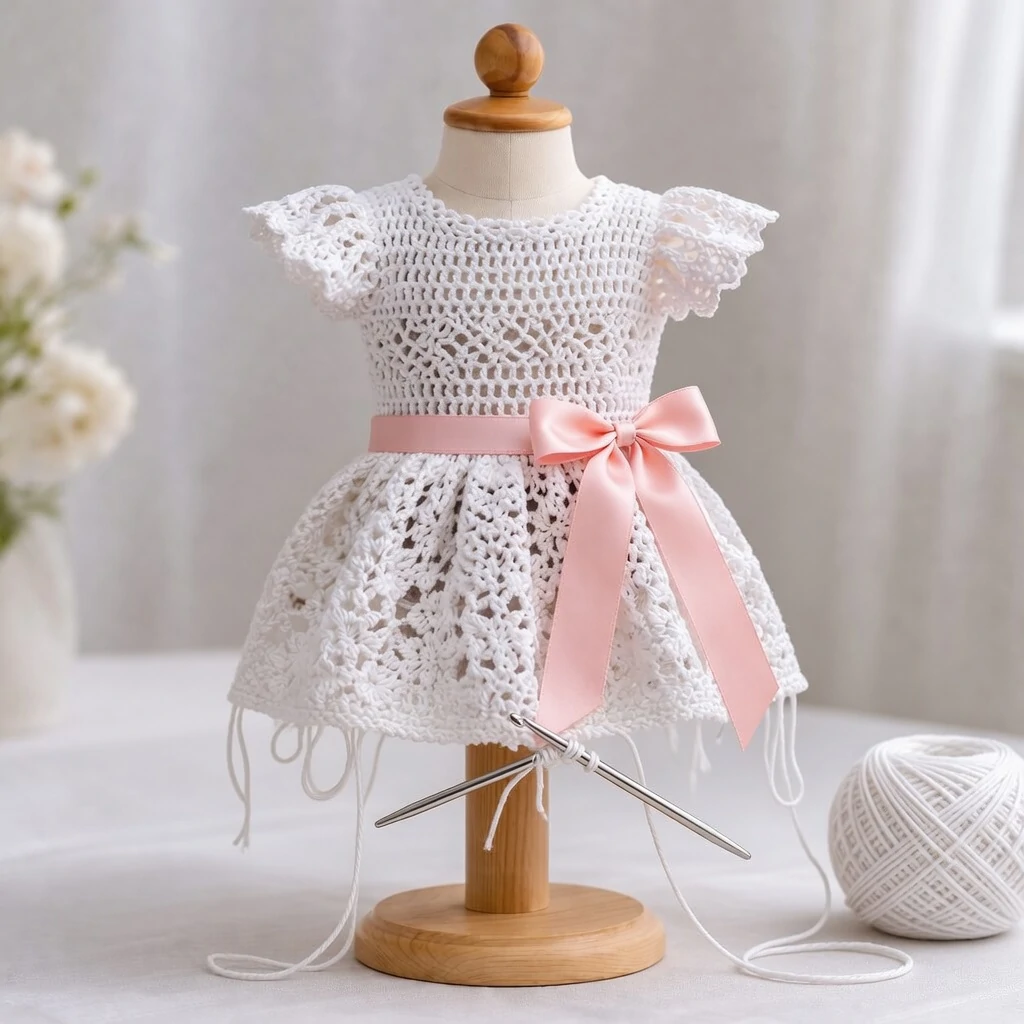
A Sweet Top-Down Baby Dress With a Button Back
One piece, no side seams, exact stitch counts for every row, and a printable PDF version.
This baby girl dress crochet PDF pattern makes a soft, easy-fit dress for a baby who is roughly three to six months old. You start at the neckline and work down, so the round yoke grows as you go. Once the yoke is deep enough, you set the armholes aside and join the rest into a flared skirt. A little shell edge finishes the hem.
Everything is done in double crochet, the only increase is “2 dc in one stitch,” and every row ends with a stitch count so you always know where you are. If you can crochet a flat rectangle with even edges, you can make this dress.
Want it as a PDF? Tap the button, then choose Save as PDF as the printer. The printout skips the menus and image notes and keeps the full pattern.
Materials and gauge
- Yarn: DK weight (weight 3, light) cotton or a cotton blend, about 350–400 yards (320–365 m). Cotton breathes well, washes easily and shows every stitch.
- Hook: 4.0 mm (G-6), or whatever size gives you the gauge below.
- Buttons: three flat buttons, about 12 mm (½ in).
- Also: one stitch marker, a tapestry needle and scissors.
Not sure which hook matches your yarn? The crochet hook size chart lists US and metric sizes side by side.
Size and fit
The Craft Yarn Council lists a chest of 17 in (43 cm) for a six-month-old baby. This dress measures 20 in (51 cm) around the chest, which leaves about 3 in of ease so it slips on over a onesie and still fits when she grows a little.
| Measurement | Finished dress |
|---|---|
| Chest (below armholes) | 20 in / 51 cm (90 sts) |
| Neck edge | 12 in / 30 cm (54 sts) + button opening |
| Armhole opening | about 7 in / 18 cm |
| Hem | 36 in / 91 cm (162 sts) |
| Length, neck to hem | about 13 in / 33 cm |
Bigger baby? For roughly 6–12 months, use a 4.5 mm hook and aim for 16 dc = 4 in. The same stitch counts then give a chest of about 22½ in. Add two or three plain skirt rounds for length.
Pattern notes and abbreviations
- US crochet terms: ch = chain, sl st = slip stitch, sc = single crochet, dc = double crochet, st(s) = stitch(es).
- The ch-2 at the start of each row or round does not count as a stitch. Always make your first dc into the very first stitch.
- The yoke is worked in rows, which leaves an opening at the back. The skirt is worked in joined rounds, and you turn after every round so the texture matches the yoke.
- “2 dc in next” is the only increase. Numbers at the end of each row are the total stitches in that row.
New to double crochet or reading counts? The how to crochet for beginners guide covers every stitch used here.
Part 1: The yoke (worked in rows)
You’ll start at the neckline. The first chain becomes the neck edge, and the back opening runs down the middle of the back.
Lay the yoke flat. It should look like a wide, curved collar about 4 in (10 cm) deep. If it ruffles, your stitches are looser than the gauge. If it cups, they’re tighter. Fix that now, before the armholes.
Part 2: Armholes and joining
This row splits the yoke into back, armhole, front, armhole and back. Place a stitch marker as you go if it helps.
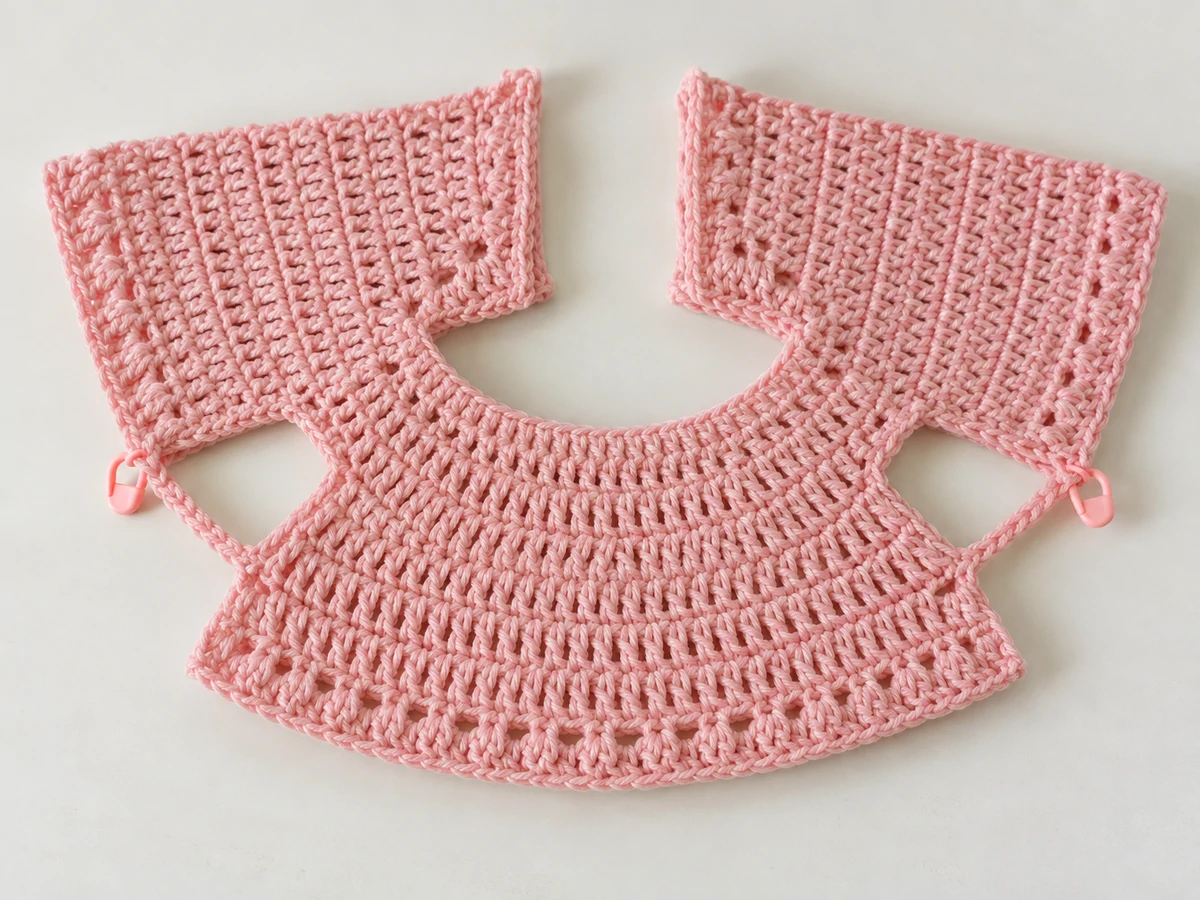
Join the back: don’t turn. Bring the two back edges together, making sure the yoke isn’t twisted, and sl st into the first dc of Row 10. From here on you work in rounds. The rows above this join stay open and become the button opening.
Part 3: The skirt (joined rounds)
For every round: ch 2, turn, work the stitches, then join with a sl st to the first dc.
Part 4: Edging, button loops and finishing
Neck and back opening
With the right side facing you, join the yarn at the bottom of the back opening on the right-hand edge (just above Round 11).
- Work 2 sc into the side of each row up the edge, which is 20 sc for Rows 1–10.
- At the top corner, 3 sc in the corner, then 1 sc in each foundation chain across the neck (54 sc), then 3 sc in the next corner.
- Work down the other back edge with 2 sc in the side of each row. At the ends of Rows 1, 4 and 8, make a button loop: sc, ch 4, sc in that row end instead of 2 sc.
- Sl st at the bottom of the opening and fasten off.
Sew the three buttons to the opposite edge, lined up with the loops. Use doubled thread and go through each button several times.
Armholes
Join the yarn at the middle of the underarm chain. Sc in each chain (7) and in each of the 26 skipped yoke stitches, for 33 sc. Join and fasten off. Repeat on the other side.
Weave in and block
Weave every end in for at least 2 in (5 cm) and change direction once so it can’t work loose. Wash the dress gently, press out the water in a towel, and dry it flat with the skirt spread into its A-line shape.
Stitch count check
Every number below has been worked out from the row before it, so you can check your count after each row.
| Row / Round | What happens | Stitches |
|---|---|---|
| Foundation | ch 56 | — |
| 1 | dc across | 54 |
| 2 | +1 every 3 sts (18 inc) | 72 |
| 3 | plain | 72 |
| 4 | +1 every 4 sts (18 inc) | 90 |
| 5 | plain | 90 |
| 6 | +1 every 5 sts (18 inc) | 108 |
| 7 | plain | 108 |
| 8 | +1 every 6 sts (18 inc) | 126 |
| 9 | +2 | 128 |
| 10 | 19 + ch 7 + 38 + ch 7 + 19 (skip 26 twice) | 90 |
| 11 | join, plain | 90 |
| 12 | +1 every 5 sts (18 inc) | 108 |
| 14 | +1 every 6 sts (18 inc) | 126 |
| 17 | +1 every 7 sts (18 inc) | 144 |
| 22 | +1 every 8 sts (18 inc) | 162 |
| 23–31 | plain | 162 |
| 32 | shell hem | 27 shells |
Common problems and fixes
- The yoke ruffles like a frill. Your stitches are looser than 18 per 4 in. Go down half a hook size and restart the yoke. It’s only 10 rows.
- The yoke curls up into a bowl. Your stitches are too tight. Go up a hook size. For more help with this, see why is my crochet curling .
- Row 10 doesn’t come out to 90. Count Row 9 first; it must be 128. Then check that you skipped exactly 26 stitches for each armhole.
- A visible seam line runs down the back of the skirt. That’s normal with joined rounds. Turning every round (as written) keeps it straight and much less noticeable.
- The dress is too short. Add plain rounds at 162 stitches before the shell hem. Each round adds about 0.4 in (1 cm).
FAQ
Is this baby girl dress crochet PDF free?
Yes, it is free. Use the “Print or save as PDF” button near the top and choose Save as PDF. The printout includes every row, the stitch count table and the finishing steps.
What yarn is best for a crochet baby dress?
A smooth DK cotton or cotton blend. It’s soft, breathable, machine washable and shows the stitches clearly. Avoid fuzzy or loosely plied yarns that shed.
How much yarn does the 3–6 months dress use?
Plan on about 350–400 yards (320–365 m) of DK yarn. Buy an extra ball from the same dye lot if you plan to lengthen the skirt.
Can a beginner make this dress?
Yes, if you are comfortable with double crochet and counting stitches. The only increase is two double crochets in one stitch, and each row lists its total.
How do I make it bigger?
Use a 4.5 mm hook at 16 dc per 4 in for roughly 6–12 months (chest about 22½ in), and add two or three plain skirt rounds.

Reader discussion
Reader Comments
Tried this pattern? Share what worked, ask a question, or help another crocheter.
Your turn
Comments are moderated to keep the discussion useful and family-friendly. Please do not post personal information.