
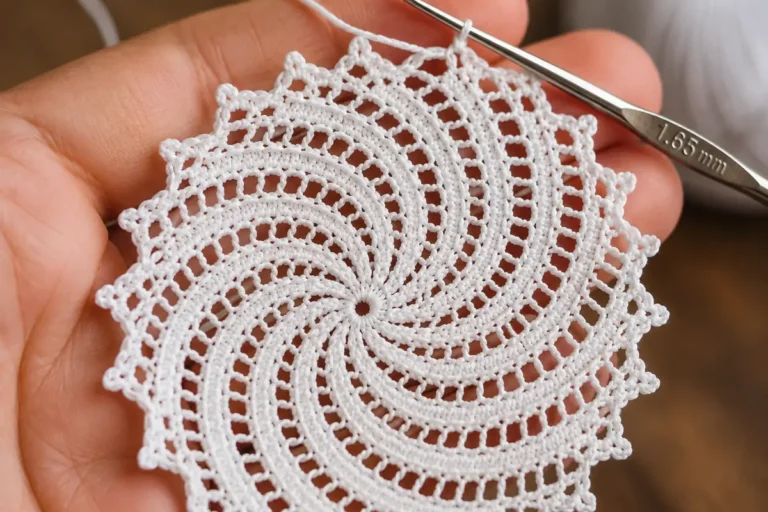
Archimedes Spiral Doily Pattern — Free Crochet Guide
Make a stunning mathematical spiral doily — complete free pattern, step-by-step instructions, and expert blocking tips
The Archimedes spiral doily pattern is one of the most mathematically elegant and visually stunning projects in all of crochet. In fact, the Archimedes spiral doily takes its name directly from the ancient Greek mathematician Archimedes, who first described this exact spiral curve around 225 BC. Furthermore, what makes this crochet spiral doily pattern so remarkable is the perfectly even, continuously expanding spiral it creates — where every turn of the spiral is exactly the same distance from the one before it. Consequently, the finished Archimedes spiral doily has an almost hypnotic quality that draws the eye inward toward the center, then outward along the expanding arms. Therefore, whether you are an experienced doily maker or trying your first spiral crochet pattern, this guide will help you make your own Archimedes spiral doily from start to finish.
In this guide, you will find a complete free Archimedes spiral doily pattern with full step-by-step instructions, materials list, blocking guidance, and color suggestions. Additionally, all instructions use US crochet terminology and are written for intermediate crocheters — however, motivated beginners will find this pattern very achievable too. If you need a refresher on thread crochet basics, check out our complete guide to thread crochet for beginners and our doily blocking tutorial before you start.
📋 What’s in this guide
- What is the Archimedes spiral doily pattern?
- Supplies and materials you need
- Skills required before you begin
- Free Archimedes spiral doily pattern — complete instructions
- How to block your finished spiral doily
- Color ideas and creative variations
- How to display and use your Archimedes spiral doily
- Frequently asked questions
1. What Is the Archimedes Spiral Doily Pattern?
Before diving into the Archimedes spiral doily pattern itself, it is worth understanding what makes it different from a regular round doily. Furthermore, this understanding will help you crochet the spiral more accurately and appreciate why specific techniques are used at each stage of the pattern.
The Mathematics Behind the Archimedes Spiral Doily
The Archimedes spiral — also called an arithmetic spiral — is a specific type of spiral in which the distance between successive turns remains perfectly constant. In contrast, other spirals (like the logarithmic spiral seen in nautilus shells) grow at an increasing rate. As a result, the Archimedes spiral has a clean, even, architectural quality that translates beautifully into crochet. Furthermore, this structure means the pattern is genuinely mathematical — you are essentially drawing geometry with yarn and a hook, stitch by stitch.
How This Spiral Doily Differs from a Round Doily
Most traditional crochet doilies are worked in joined rounds, where each round ends with a slip stitch join. However, the Archimedes spiral doily pattern is worked in a continuous spiral — you never join rounds at all. Consequently, the finished doily has no visible seam lines between rounds, creating a smooth, unbroken spiral line that gives the design its distinctive mathematical appearance. Furthermore, this construction also means there are no gaps or holes at round joins, which produces a more solid and elegant finished surface overall.
“Crochet is the meeting point of mathematics and art — and the Archimedes spiral doily is perhaps the most beautiful proof of that truth.”
The Archimedes spiral doily pattern is best suited for intermediate crocheters comfortable with thread crochet, the magic ring, and working in continuous rounds. However, motivated beginners who have already completed a few basic doily patterns will find this pattern very achievable with patience. Furthermore, if you are completely new to thread crochet, our beginner thread crochet guide covers all the foundational skills you need before starting.
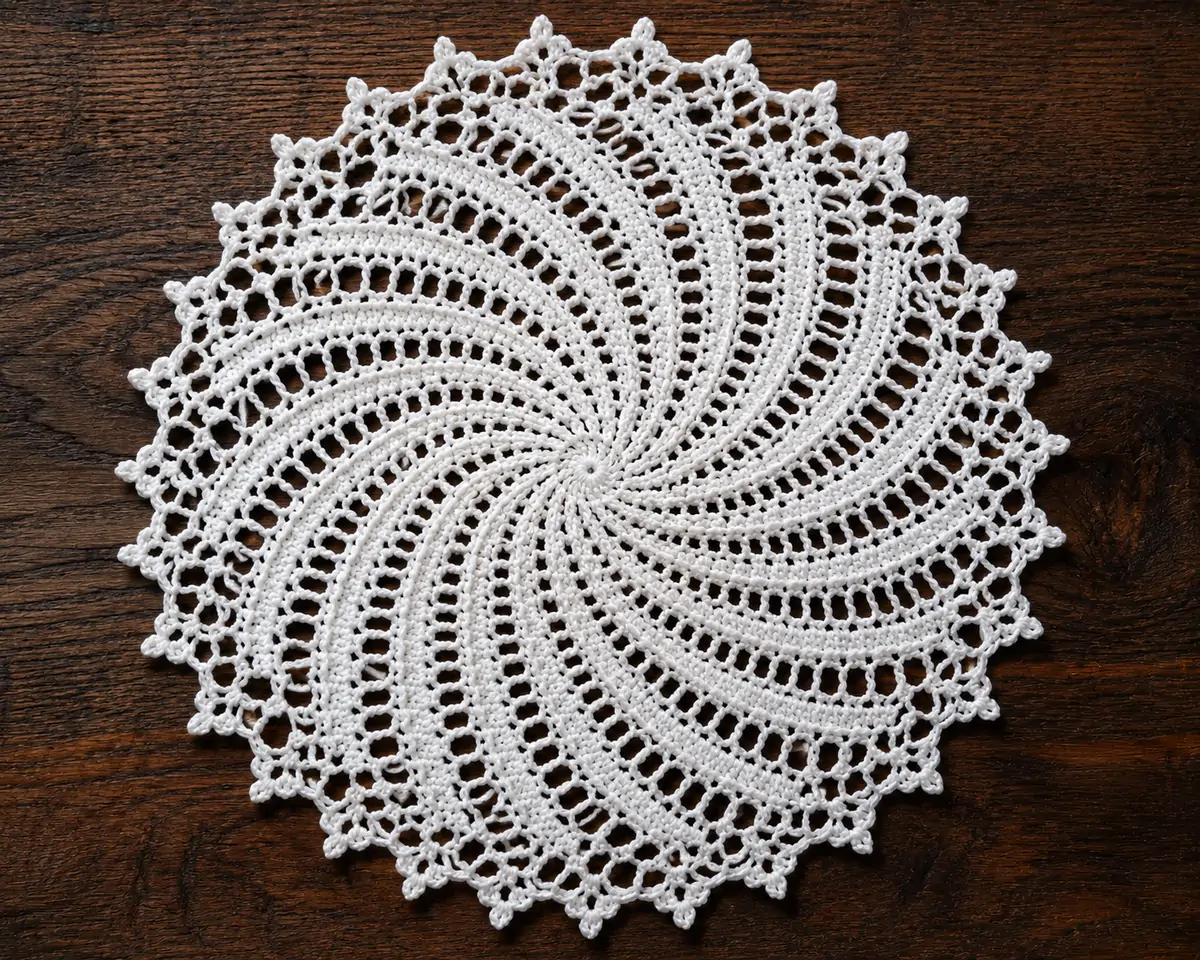
A finished Archimedes spiral doily pattern in white cotton thread — where mathematics and crochet become the same beautiful thing.
2. Supplies for the Archimedes Spiral Doily Pattern
One of the most appealing aspects of the Archimedes spiral doily pattern is that it requires very few supplies. Furthermore, the thread and hook are the two most important choices — consequently, selecting them carefully will have the biggest impact on your finished doily’s appearance and quality.
Essential Materials List
Crochet Thread
Size 10 cotton crochet thread is the most popular choice for spiral doilies. Furthermore, it produces a fine, crisp result that blocks beautifully. Approximately 200–300 yards needed depending on final size.
Steel Crochet Hook
1.65mm (US Size 7 steel) for size 10 thread. Additionally, a 1.5mm hook creates a slightly tighter, more rigid doily that holds its shape even better after blocking.
Blocking Supplies
Blocking is absolutely essential for this pattern. You will need: a foam blocking board, at least 30 stainless T-pins, a spray bottle with water, and liquid starch or blocking spray.
Yarn Needle
A fine tapestry needle for weaving in thread tails securely. Furthermore, use one with a small enough eye for size 10 thread so the weaving stays invisible.
Measuring Tape
Useful for checking the doily’s diameter as you progress. Additionally, helps when blocking to ensure the spiral arms are evenly and symmetrically spaced.
Stitch Marker
A locking stitch marker to mark the beginning of each spiral round. Consequently, you will always know exactly where you are in the pattern without losing your place mid-spiral.
Best Thread Brands for Spiral Crochet Doilies
For the best results with an Archimedes spiral doily pattern, use 100% mercerized cotton thread in size 10. Specifically, Aunt Lydia’s Classic Crochet Thread Size 10 is the most widely used and highly recommended option — smooth, consistent, and available in dozens of colors. Furthermore, Lizbeth Size 10 is an excellent premium option with particularly beautiful color saturation. Additionally, always avoid synthetic threads for this pattern because they do not block as effectively as cotton — consequently, your spiral doily may not lie flat without a natural fiber that responds well to wet blocking.

Everything you need for the Archimedes spiral doily pattern — simple supplies, but the result is anything but simple.
3. Skills Required for the Archimedes Spiral Doily Pattern
The Archimedes spiral doily pattern requires a specific set of crochet skills. Furthermore, being comfortable with each of these techniques before you begin will make the process significantly more enjoyable and successful. Therefore, review this list carefully before starting.
Magic Ring — Starting the Spiral Center
Magic Ring (Magic Circle)
The Archimedes spiral doily pattern starts with a magic ring — consequently, this is the first technique to master. A magic ring creates a perfectly closed center with no hole, which is essential for the tight, precise center of the spiral. Furthermore, unlike a foundation chain ring, the magic ring can be pulled completely closed, giving the doily a clean, professional center point that makes the spiral effect far more striking and mathematically accurate.
Continuous Spiral Construction
Working in a Continuous Spiral — No Joining
Unlike most round crochet projects, the Archimedes spiral doily is worked in a continuous spiral — meaning you never join rounds with a slip stitch. Instead, you simply continue crocheting in a spiral, moving the stitch marker up as you complete each round. As a result, the pattern has no visible seam lines, which is exactly what creates that smooth, unbroken, mathematically precise spiral appearance. Furthermore, using a locking stitch marker at all times is absolutely essential — without it, you will quickly lose track of your position in the spiral.
Thread Tension Control
Consistent Thread Tension Throughout
Thread crochet requires significantly tighter and more controlled tension than standard yarn crochet. Consequently, if you normally crochet loosely, you may need to consciously tighten your grip when working this pattern. Furthermore, inconsistent tension in a spiral doily is immediately visible — the spiral arms will widen and narrow unevenly, disrupting the mathematical precision that makes this pattern so beautiful. Therefore, practice with scrap thread first to find your natural thread tension. Additionally, wrapping the thread around your index finger one extra time helps many crocheters maintain the consistent grip that thread crochet requires.
4. Free Archimedes Spiral Doily Pattern — Complete Instructions
This free Archimedes spiral doily pattern produces a finished doily approximately 20–22cm in diameter when blocked, using size 10 thread and a 1.65mm steel hook. Furthermore, the design creates six evenly spaced spiral arms expanding from a central point. As a result, you get a beautifully balanced doily with a clear, readable spiral that is immediately recognizable as the classic Archimedes curve. Additionally, all pattern instructions use US crochet terminology throughout.
Pattern Notes and Special Instructions
🌀 The Archimedes Spiral Doily — Free Pattern
Materials
- Size 10 cotton thread — white or ecru (~250 yards)
- 1.65mm (US Size 7) steel crochet hook
- Locking stitch marker
- Fine tapestry needle
- Blocking board, T-pins, starch spray
Finished Size
- Unblocked: ~17cm diameter
- Blocked: ~20–22cm diameter
- Spiral arms: 6 complete turns
- Skill level: Intermediate
- Time: 4–6 hours
Abbreviations — US Terms
CENTER: Make a magic ring. Ch 1 (does not count as a stitch). Work 6 sc into the ring. Pull ring closed firmly. Place marker in first sc = 6 sts. Do not join — begin spiraling immediately.
ROUND 1: Inc in each of next 6 sc = 12 sts. Move marker to first stitch of next round. Consequently, your work is now a flat circle of 12 evenly spaced stitches.
ROUND 2: (Sc, inc) repeat 6 times = 18 sts. Move marker. Furthermore, from this point onward the 6 spiral arms begin to become visible as distinct lines in the fabric.
ROUND 3: (Sc×2, inc) repeat 6 times = 24 sts. Move marker.
ROUND 4: (Sc×3, inc) repeat 6 times = 30 sts. Move marker.
ROUNDS 5–10 — Building the Archimedes Spiral Arms: Continue the established increase pattern — each round adds 1 additional sc between increases. Therefore: R5=36, R6=42, R7=48, R8=54, R9=60, R10=66 sts. As a result, the 6 spiral arms are now clearly defined and perfectly even — this is the Archimedes spiral geometry becoming visible in your work.
ROUNDS 11–16 — Spiral Development: R11=72, R12=78, R13=84, R14=90, R15=96, R16=102 sts. Furthermore, by Round 16, the Archimedes spiral pattern should be clearly and beautifully visible — check that the spacing between spiral arms is perfectly even and consistent throughout.
ROUNDS 17–20 — Outer Expansion: R17=108, R18=114, R19=120, R20=126 sts. Consequently, your doily is now approximately 15cm in diameter with 5 full spiral arm rotations complete around the center point.
DECORATIVE OUTER EDGE (optional): After completing Round 20, work a sl st to join the round. Subsequently, work 1 round of (sc, ch 3, skip 2 sts) around the entire outer edge = a clean picot-like edge that gives the spiral doily a more finished, traditional doily appearance. Sl st to join. FO.
FINISHING: Weave in both thread tails very securely on the wrong side, going in different directions with each pass. Furthermore, trim tails to approximately 1cm after weaving. As a result, the ends will be completely invisible on the right side of your finished Archimedes spiral doily.
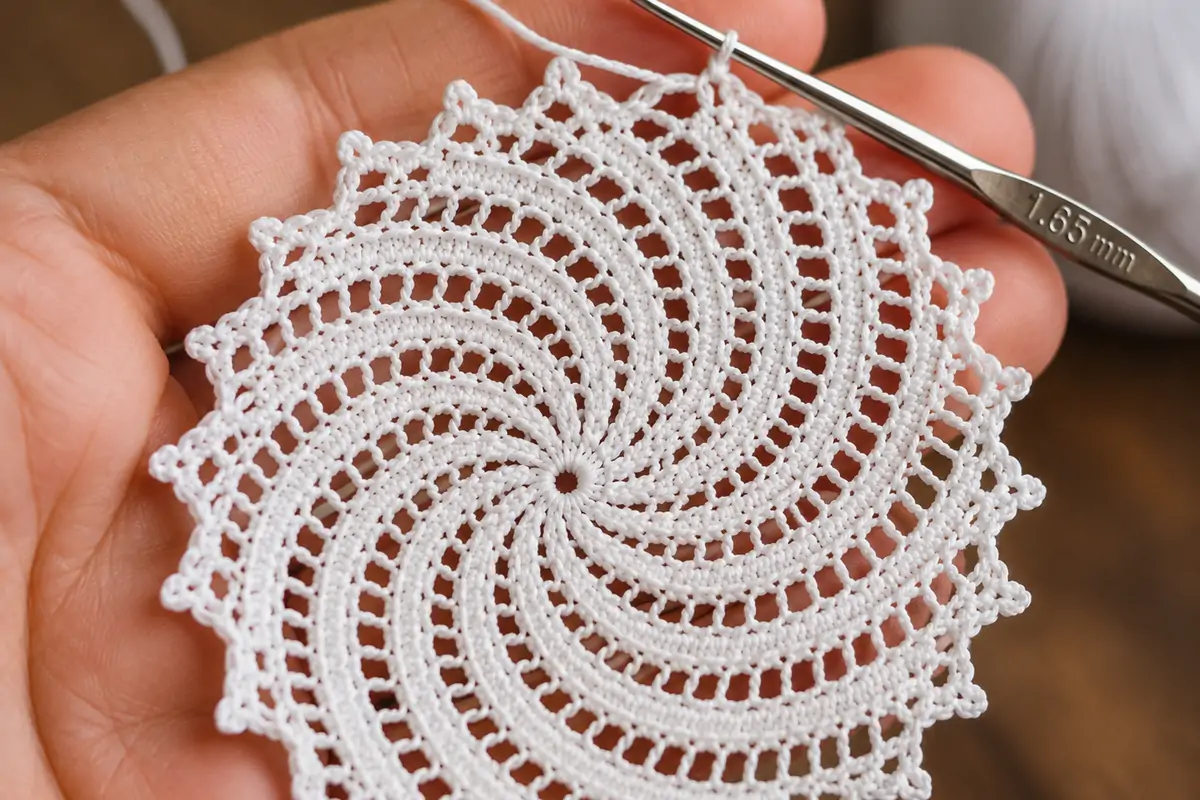
The Archimedes spiral arms become clearly visible from around Round 8 — one of the most satisfying moments in making this pattern!
5. How to Block Your Archimedes Spiral Doily Pattern
Blocking is not optional for the Archimedes spiral doily pattern — it is an absolutely essential step. Furthermore, an unblocked spiral doily will look uneven and may not lie flat at all. In contrast, a properly blocked doily transforms completely, opening up the stitches, evening out tension inconsistencies, and making the mathematical Archimedes spiral geometry strikingly clear and precise. Therefore, take time to block your doily carefully — the result is worth every extra minute.
Step-by-Step Wet Blocking Method
Soak the Doily in Cool Water
Fill a clean bowl with cool water and a drop of gentle wool wash. Submerge the doily completely and gently press it down to saturate the thread fully. Furthermore, let it soak for at least 15–20 minutes — consequently, the cotton fibers relax completely and become much more malleable for shaping. However, do not wring or twist the doily — instead, gently squeeze out excess water by pressing the doily between two clean towels.
Pin the Doily to Shape
Place the damp doily on your blocking board and gently shape it into a perfect circle. Furthermore, use a circular template to ensure the outer edge is truly round. Subsequently, pin the outer edge with T-pins at approximately 2cm intervals, stretching the doily gently outward as you pin. As a result, the spiral arms will separate and become clearly defined. Additionally, pin the spiral arm lines at equal intervals — this is what gives the finished Archimedes spiral doily its precise mathematical appearance.
Apply Starch and Dry Completely
Once pinned, spray the doily generously with liquid starch spray or diluted fabric stiffener. Furthermore, ensure the entire surface is evenly coated. Then leave the doily pinned to the board until it is completely dry — typically 12–24 hours depending on humidity. Consequently, removing the pins before the doily is fully dry will cause it to lose its shape entirely. As a result of thorough blocking and starching, your finished Archimedes spiral doily pattern result will hold its shape perfectly and lie completely flat on any surface.
6. Color Ideas for the Archimedes Spiral Doily Pattern
While the classic Archimedes spiral doily pattern is traditionally worked in white or ecru cotton thread, there are many creative color possibilities. Furthermore, modern crocheters have discovered that this pattern works beautifully in a much wider range of colors. Therefore, here are the most popular and visually striking options:
Most Popular Color Combinations
Classic White
The most traditional choice. Crisp, elegant, and timeless — white cotton is the gold standard for the Archimedes spiral doily.
Ecru / Natural
Softer than bright white. Gives the doily a warm, vintage quality that looks beautiful on dark wood surfaces.
Pale Blue
A subtle modern twist. Furthermore, pale blue spiral doilies look stunning displayed on white or cream-painted furniture.
Dusty Rose
Romantic and soft. Consequently, this color choice makes the doily work beautifully as a dresser or vanity accent piece.
Sage Green
Fresh and botanical. Additionally, sage green spiral doilies pair beautifully with natural wood and plant-filled spaces.
Lavender
Delicate and feminine. Furthermore, lavender gives this spiral doily pattern a dreamy quality perfect as a display piece.
Creative Pattern Variations
Beyond color, there are several ways to creatively vary the Archimedes spiral doily pattern. For example, you can work the outer rounds in a contrasting color to highlight the edge of the spiral dramatically. Additionally, using a slightly larger hook (1.9mm instead of 1.65mm) with the same size 10 thread creates a more open, lacy texture. Furthermore, you can vary the number of spiral arms — working with 5 increases per round instead of 6 creates a beautifully asymmetric five-arm spiral, while 4 increases per round produces a more square-like shape. As a result, one basic pattern structure can produce a surprisingly wide variety of finished doilies from the same set of instructions.
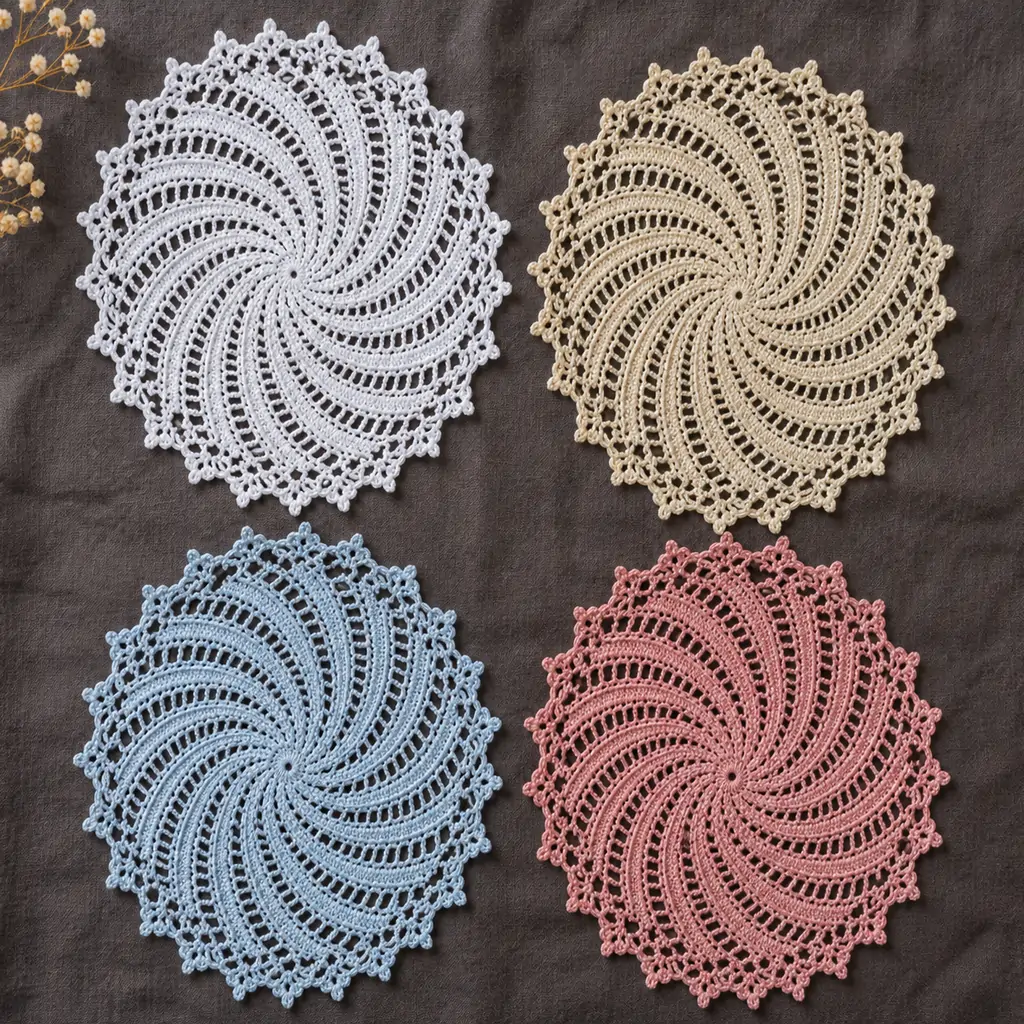
The same Archimedes spiral doily pattern in different colors — same mathematics, completely different moods and personalities.
7. How to Display and Gift Your Archimedes Spiral Doily
Once your Archimedes spiral doily pattern is complete, blocked, and fully dry, the possibilities for displaying and using it are wonderfully varied. Furthermore, the unique spiral design gives this doily a visual power that most round doilies simply do not have — consequently, even a single doily becomes a genuine focal point wherever you place it.
Home Display Ideas for Your Spiral Doily
The most traditional use is as a table centerpiece doily — placed flat on a dining table, coffee table, or side table to protect the surface while adding an elegant handmade touch. Furthermore, a vase, candle, or small decorative object placed at the very center of the spiral draws the eye beautifully inward along the mathematical curve. Additionally, the Archimedes spiral doily works beautifully as a dresser accent — placed under perfume bottles, a jewelry dish, or a small lamp. Moreover, framing a blocked spiral doily behind glass and hanging it as wall art is an increasingly popular way to display this beautifully mathematical design. As a result, the doily becomes a piece of fiber art that celebrates both craft and geometry simultaneously. For more free doily patterns, visit Ravelry’s free doily collection.
Gifting Ideas for This Special Pattern
A handmade Archimedes spiral doily makes an exceptionally thoughtful and unique gift for housewarmings, weddings, anniversaries, and for anyone who appreciates mathematics, science, or fine handcraft. Furthermore, presenting the doily with a small card explaining the Archimedes spiral’s mathematical history adds an educational and personal dimension that makes it truly unforgettable. Additionally, pairing the doily with a simple wooden frame or a glass display dome gives the recipient an immediate and beautiful way to display it. Moreover, explore our full free doily pattern collection if you want to make a complete set of mathematical crochet doilies as a gift.
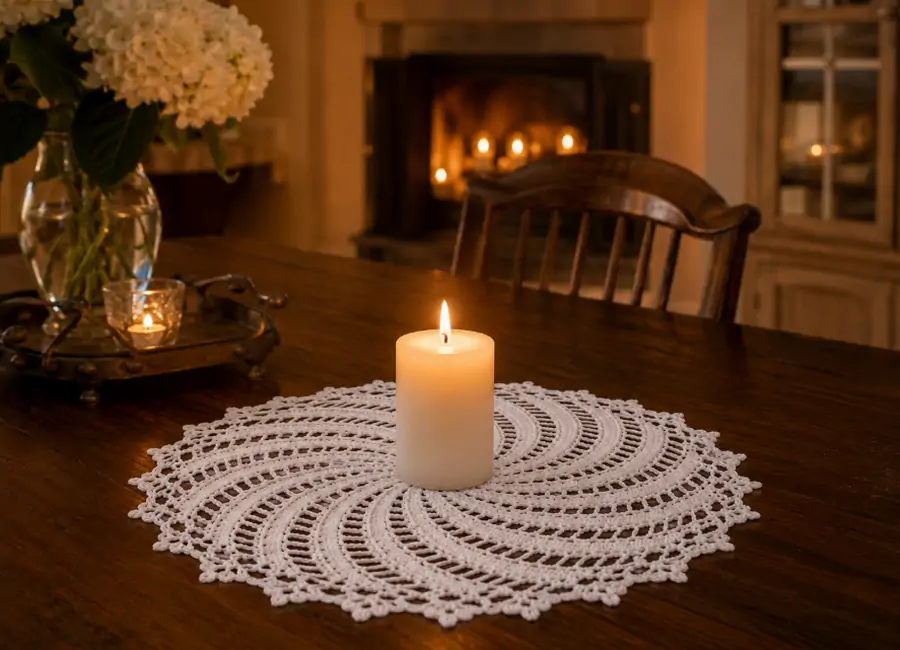
The Archimedes spiral doily as a candlelit table centerpiece — the spiral draws the eye beautifully toward whatever you place at its center.
8. Frequently Asked Questions About the Archimedes Spiral Doily Pattern
What makes an Archimedes spiral doily different from a regular round doily?
The key difference is the construction method. A regular round doily is worked in joined rounds — each round ends with a slip stitch join before the next begins. In contrast, the Archimedes spiral doily pattern is worked in a continuous spiral with no joins at all. Consequently, there are no visible seam lines between rounds, and the finished doily has a smooth, unbroken spiral line that gives it its distinctive mathematical appearance. Furthermore, the stitch count increases at a mathematically precise and constant rate, which is exactly what creates the evenly-spaced Archimedes spiral geometry.
Is the Archimedes spiral doily pattern suitable for beginners?
The Archimedes spiral doily is best suited for intermediate crocheters. However, motivated beginners who have completed at least 2–3 other doily or thread crochet projects will find this pattern achievable with patience. Furthermore, the most challenging aspects are maintaining consistent thread tension and tracking the continuous spiral without losing your place. Additionally, using a stitch marker at all times is essential — do not attempt this pattern without one. Therefore, start with our beginner doily pattern first if you have never worked with thread before.
What thread size is best for the Archimedes spiral doily pattern?
Size 10 cotton crochet thread is overwhelmingly the most popular choice for the Archimedes spiral doily pattern. Furthermore, it produces a doily of a practical size (approximately 20–22cm when blocked) with clearly defined stitches. However, you can also use size 20 thread for a finer, more delicate result — as a result, the finished piece will be slightly smaller and more intricate. Additionally, always choose 100% mercerized cotton for the best blocking results, as synthetic threads do not respond to blocking as well.
Do I have to block the Archimedes spiral doily?
Yes — blocking is absolutely essential for this spiral doily pattern. In fact, blocking is the step that transforms the doily from a somewhat uneven piece of thread work into the precise, flat, mathematically beautiful object it is designed to be. Furthermore, without blocking, the spiral arms will not separate clearly, the doily will not lie flat, and the Archimedes spiral geometry will not be visible. Consequently, never skip the blocking step. Additionally, using liquid starch alongside wet blocking gives the finished Archimedes spiral doily a crisp finish that holds its shape permanently.
How long does it take to crochet an Archimedes spiral doily?
Most intermediate crocheters complete the 20-round Archimedes spiral doily pattern in approximately 4–6 hours of crochet time, spread over 2–3 sessions. Furthermore, blocking and drying adds an additional 12–24 hours. Therefore, the full project from start to finished, blocked doily typically takes about 2 days. However, beginners should expect to take longer — additionally, you may need to restart the center once or twice before your tension settles and the spiral begins to develop evenly.
Can I make the Archimedes spiral doily larger or smaller?
Yes, absolutely! The beauty of the Archimedes spiral doily pattern is that it is infinitely scalable. Furthermore, to make it larger, simply continue adding rounds following the established increase pattern (one additional sc between increases per round). Conversely, to make it smaller, stop at an earlier round — for example, stopping at Round 14 produces a smaller coaster-sized doily of approximately 12–14cm. Additionally, switching thread weight changes the finished size significantly — specifically, size 20 thread produces a smaller doily while size 10 thread produces the standard size described in this free pattern.
Ready to Make Your Archimedes Spiral Doily? 🌀
Grab your size 10 thread, your steel hook, and your stitch marker. The most mathematical doily you will ever make is waiting for you!
Explore More Free Doily Patterns →





5 thoughts on “Archimedes Spiral Doily Pattern — Free Crochet Guide”