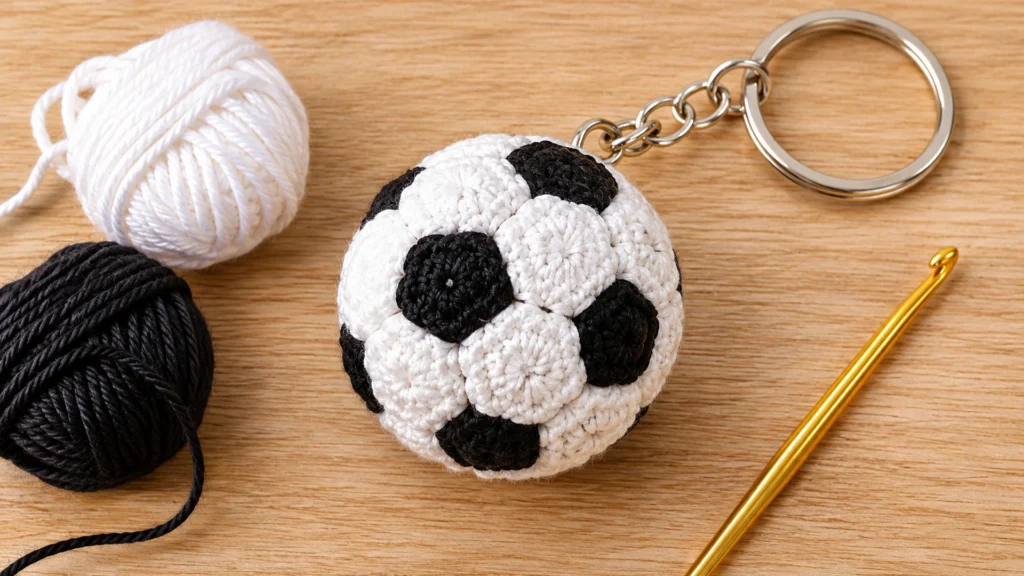
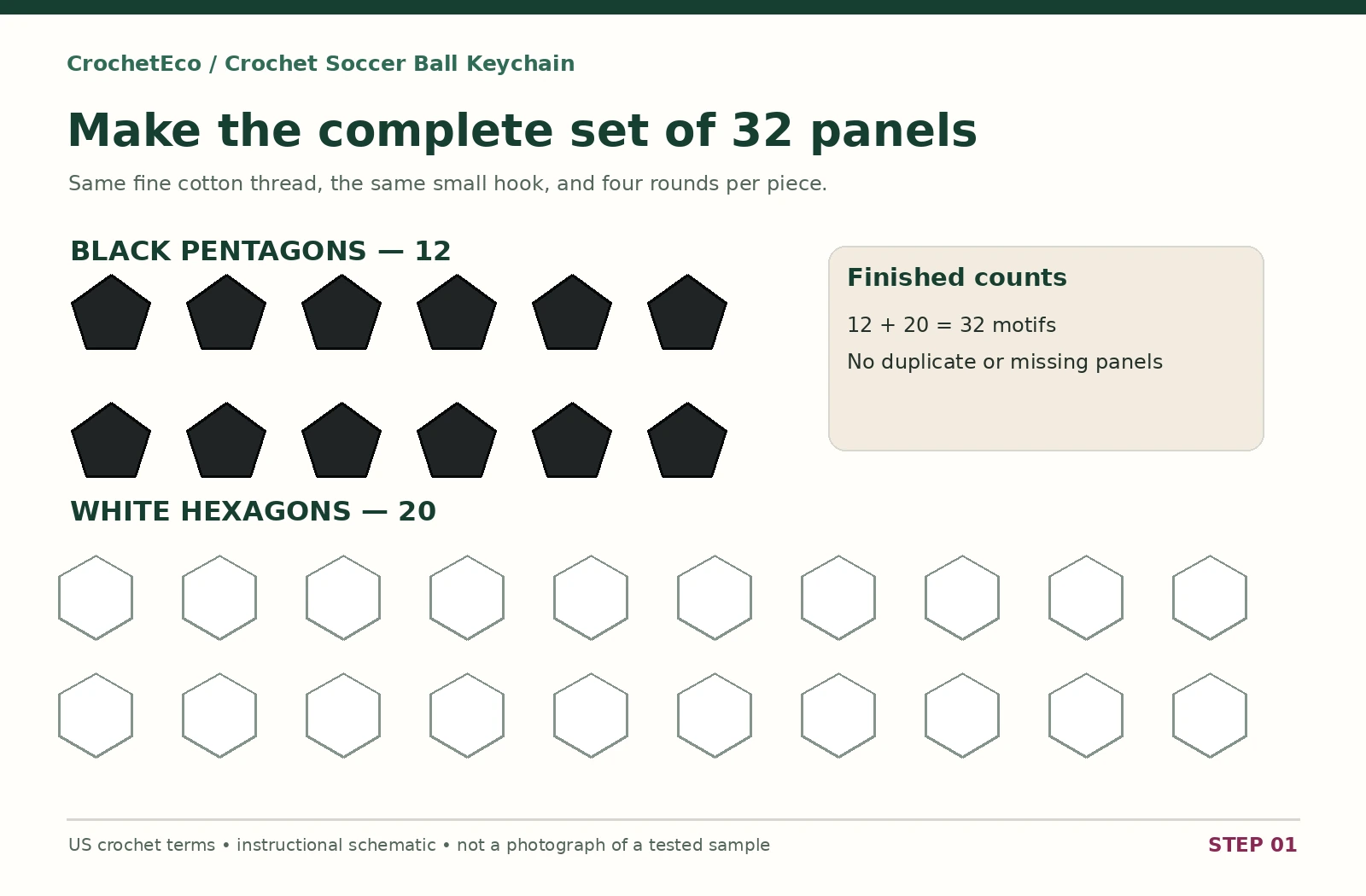
This free crochet soccer ball keychain pattern uses twelve black pentagons and twenty white hexagons to make a small stuffed soccer ball. The pieces are worked in single crochet, joined into two halves, and finished with a metal key ring. Follow the labeled assembly maps so every black patch ends up in the right place.
- Skill level
- Intermediate: simple stitches, detailed joining
- Yarn
- Fine black and white cotton crochet thread
- Hook
- Start with a 1.5–2 mm hook; adjust for thread
- Pieces
- 12 black pentagons and 20 white hexagons
- Each shared side
- 4 single crochet stitches
- Finished size
- Depends on thread and gauge; not sample-tested
- Method
- Two 16-piece halves joined and stuffed
- Use
- Decorative adult keychain or bag charm
Materials, gauge and US crochet terms
Use smooth black and white cotton thread of the same thickness. Fine thread and a small hook will give a smaller charm. You’ll also need a blunt yarn needle, stitch markers, scissors, a little polyester stuffing, a split key ring and a short metal chain. A fine sewing needle and strong matching thread can help secure the hardware.
Work one black pentagon and one white hexagon before making the whole set. At their final round, measure one marked four-stitch edge on each piece. The two edges must have the same length. As a rough geometric guide, the completed ball will be about five panel-edge lengths across, before changes from stuffing and seam tension. This is not a tested finished measurement.
For help choosing a hook, see the CrochetEco hook size chart. If you are new to the stitch, start with the beginner single crochet guide.
Open the stitch abbreviations
MR = magic ring; ch = chain; sc = single crochet; inc = work 2 sc into one stitch; sl st = slip stitch; st = stitch; R = round.
All motifs use joined rounds. Chain 1 at the start of a round, but do not count it as a stitch. Join with a slip stitch into the first sc. Do not count the joining slip stitch either.
Crochet soccer ball keychain pattern: Step 1
Make the 12 black pentagons
Each black motif has five sides. Crochet one first, count its outer edge, and then repeat it until you have twelve matching pieces. Use black thread throughout.
Round 1: Make a magic ring. Work 5 sc into the ring and join. (5 sc)
Round 2: Ch 1. Work 2 sc into each stitch and join. (10 sc)
Round 3: Ch 1. Work *1 sc, inc* five times in all. Join. (15 sc)
Round 4: Ch 1. Work *2 sc, inc* five times in all. Join. (20 sc)
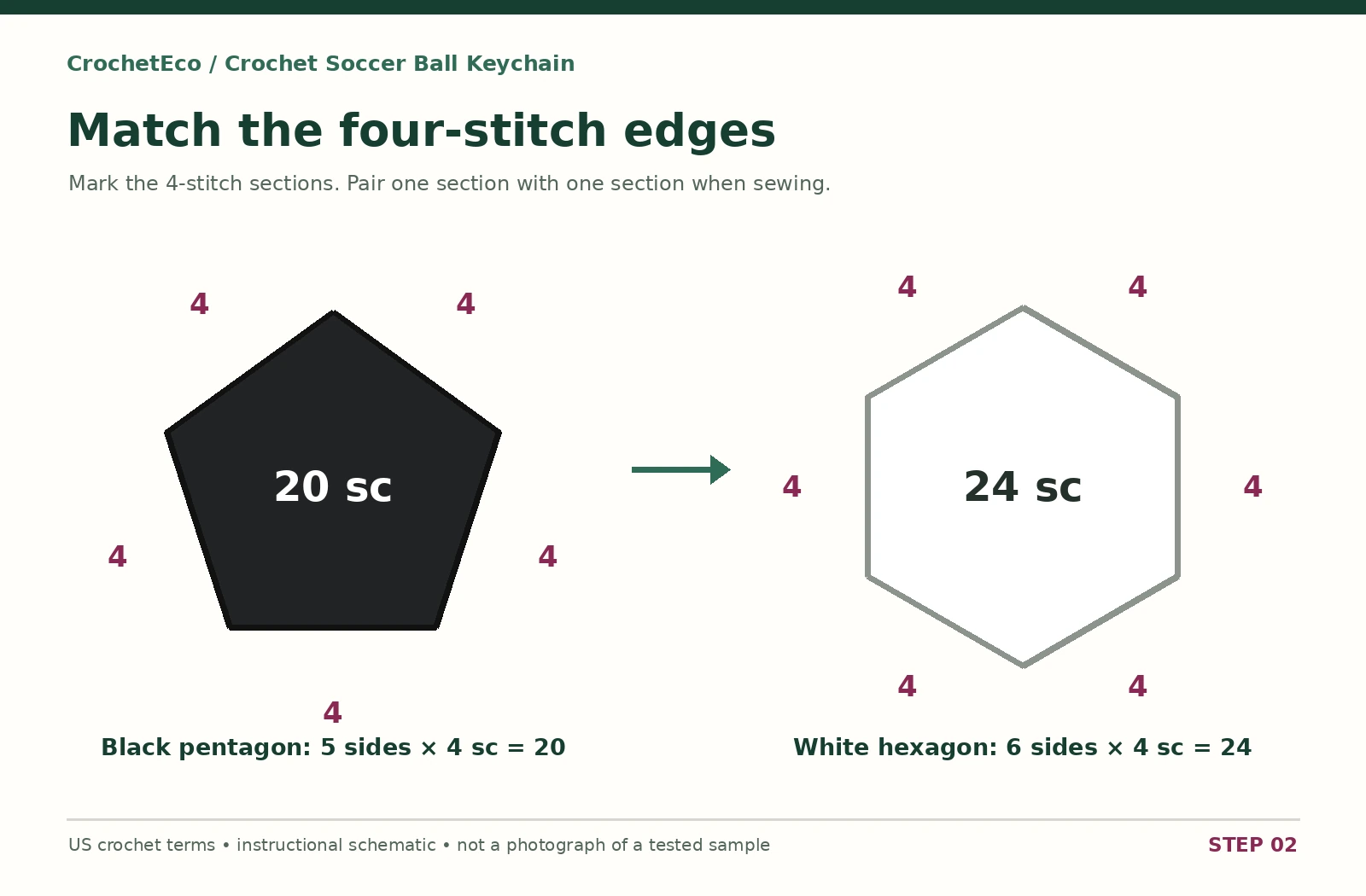
Fasten off, leaving a tail for sewing. Mark a division after every four outer sc stitches. You now have five four-stitch edges.
Step 2. Crochet the 20 white hexagons
A white hexagon has six sides, so begin with six stitches rather than five. It is normal for the finished piece to look softly rounded before you sew it to its neighbors.
Round 1: Make a magic ring. Work 6 sc into the ring and join. (6 sc)
Round 2: Ch 1. Work 2 sc into each stitch and join. (12 sc)
Round 3: Ch 1. Work *1 sc, inc* six times in all. Join. (18 sc)
Round 4: Ch 1. Work *2 sc, inc* six times in all. Join. (24 sc)
Fasten off, leaving a tail. Mark six sections, each containing four outer stitches. Make twenty white pieces altogether.
Step 3. Match every four-stitch edge
The secret to an even soccer ball is joining edges of equal length. Place two pieces with their right sides facing outward. Align one marked four-stitch section on the first piece with one four-stitch section on the second.
Use a fine yarn needle and small mattress stitches. Catch one corresponding stitch on each edge, working through all four positions. Close each seam from one corner marker to the next. Do not catch a fifth stitch or pull so tightly that the panels pucker.
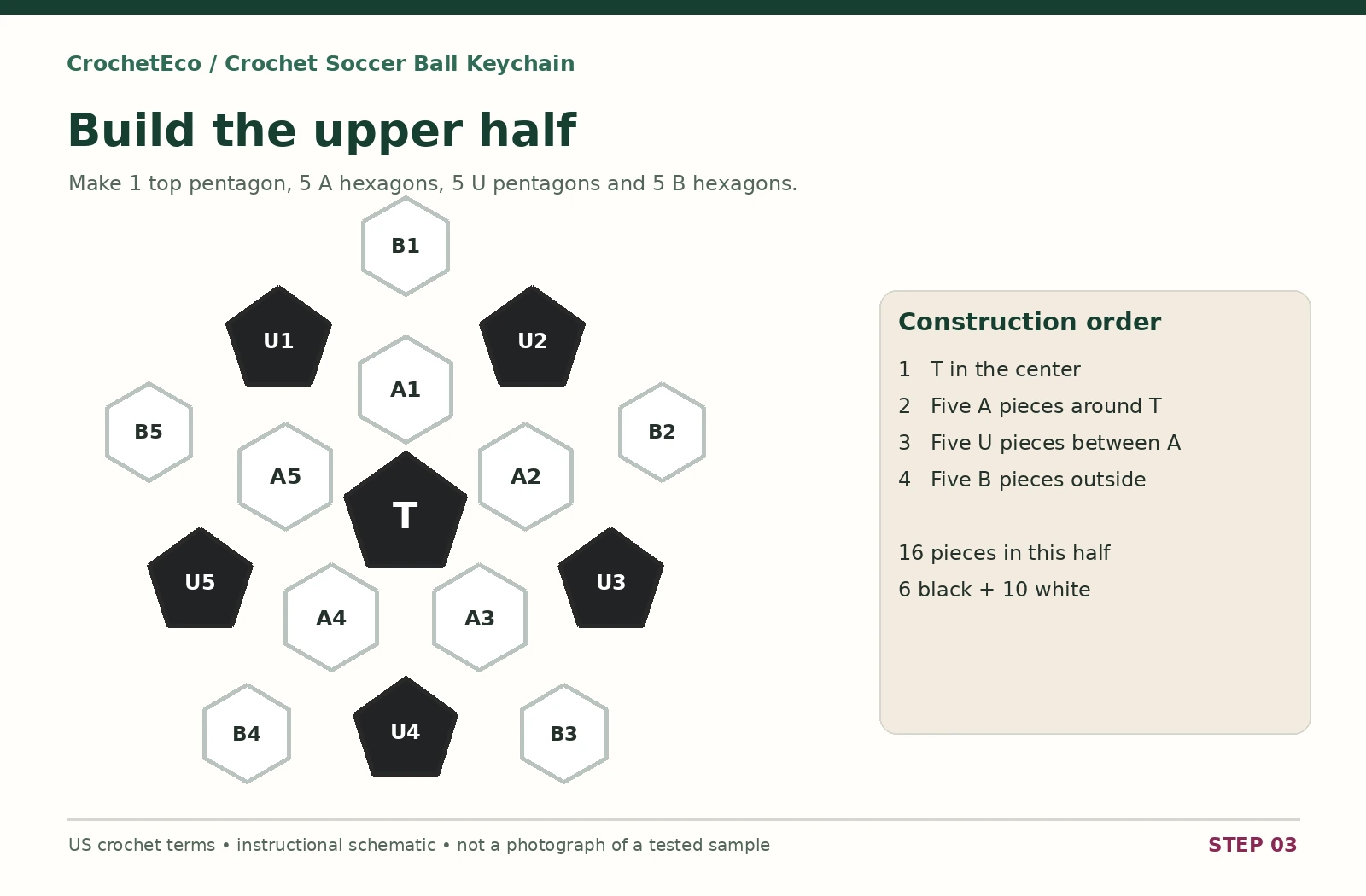
Step 4. Sew the upper sixteen-piece half
Give the pieces temporary labels using removable thread markers. They are sewing labels, not marks to embroider onto the finished ball. Count clockwise when viewing the outside.
1. Put one black pentagon, T, in the center. Sew the first edge of white hexagons A1–A5 to its five sides.
2. Sew each neighboring pair of A hexagons together along their touching side. Close the ring of five.
3. Put a black U piece between each pair of A pieces. U1 touches A5 and A1; U2 touches A1 and A2; continue around to U5 touching A4 and A5.
4. Add five outer white B pieces. Each B(i) joins to A(i), U(i), and U(i+1). After U5, return to U1.
Step 5. Sew the lower sixteen-piece half
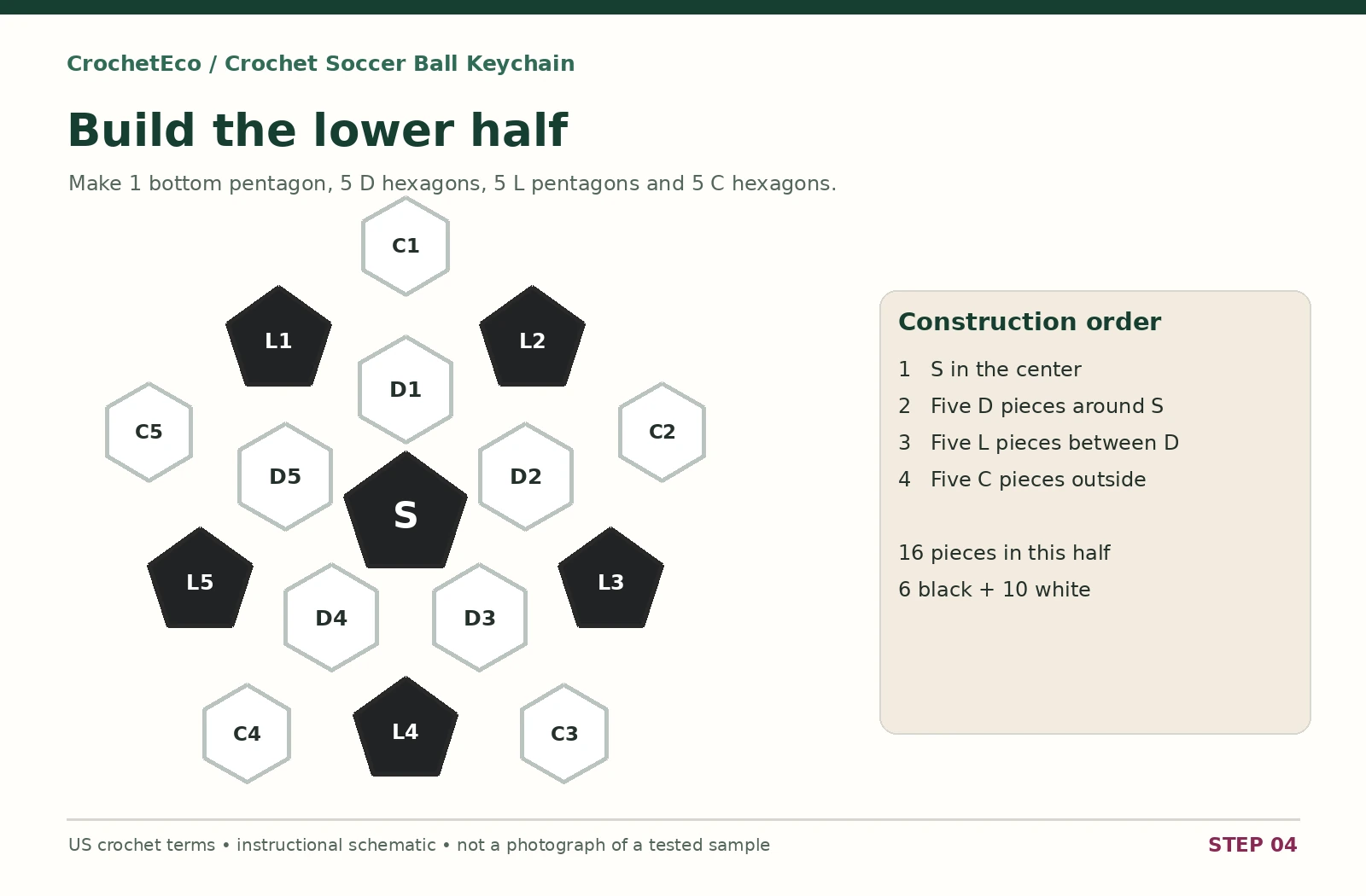
The lower half repeats the same general shape but uses its own labels. Set the second black center piece S on the table, and work outward.
1. Attach five white D hexagons, D1–D5, around S. Join neighboring D pieces along their touching edges.
2. Place black L(i) between D(i−1) and D(i). For L1, use D5 and D1; for L2, use D1 and D2, and continue around.
3. Add five outer white C pieces. C(i) joins to D(i−1), L(i−1), and L(i). The labels wrap from 5 back to 1.
Step 6. Join the halves, then add stuffing
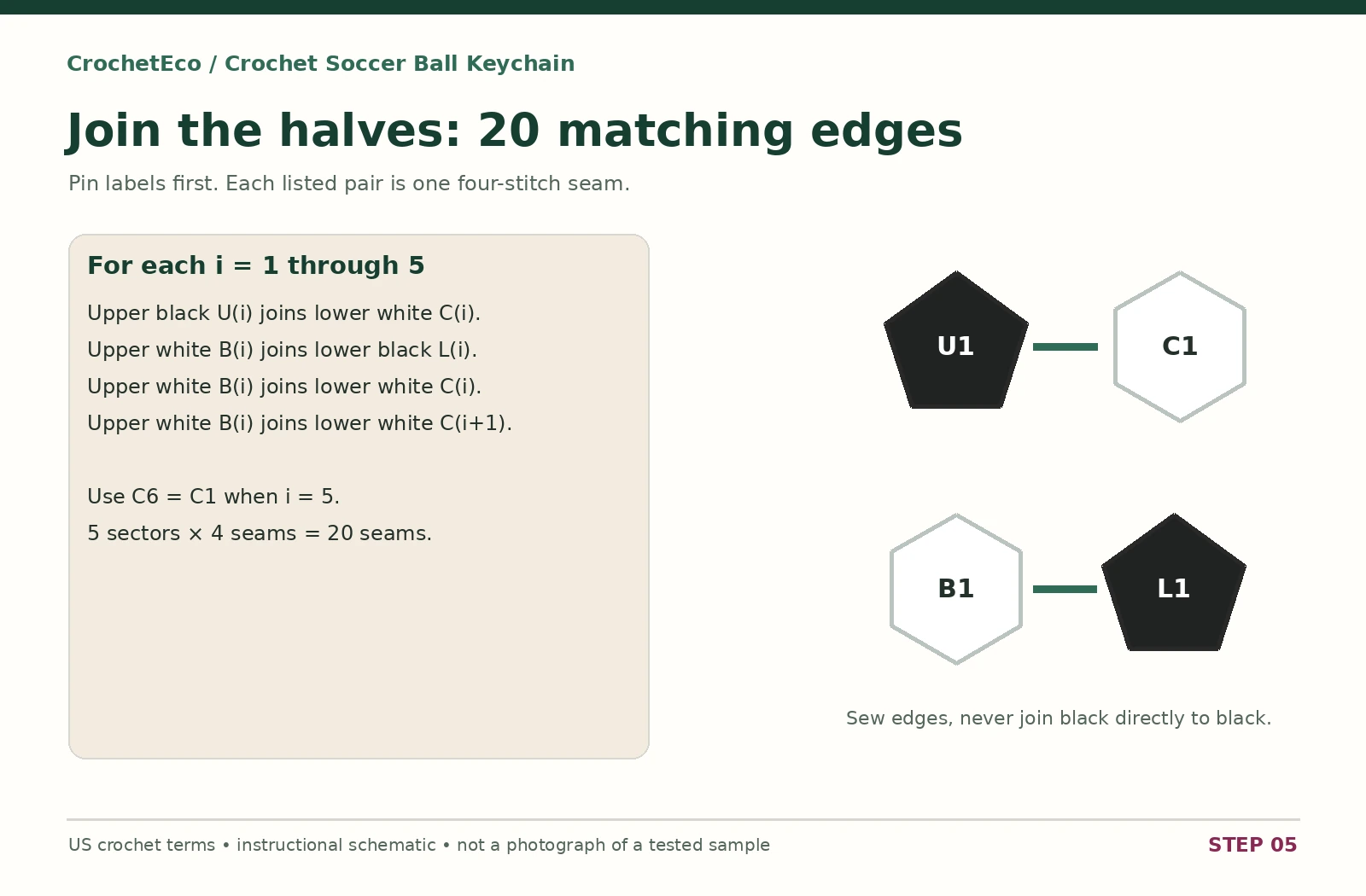
Hold the halves together, right sides out. Rotate the lower half until the outer-edge labels match the following sewing plan. Use clips or spare yarn to pin several edges before you start.
| Sector | Four seams to close |
|---|---|
| 1 | U1–C1; B1–L1; B1–C1; B1–C2 |
| 2 | U2–C2; B2–L2; B2–C2; B2–C3 |
| 3 | U3–C3; B3–L3; B3–C3; B3–C4 |
| 4 | U4–C4; B4–L4; B4–C4; B4–C5 |
| 5 | U5–C5; B5–L5; B5–C5; B5–C1 |
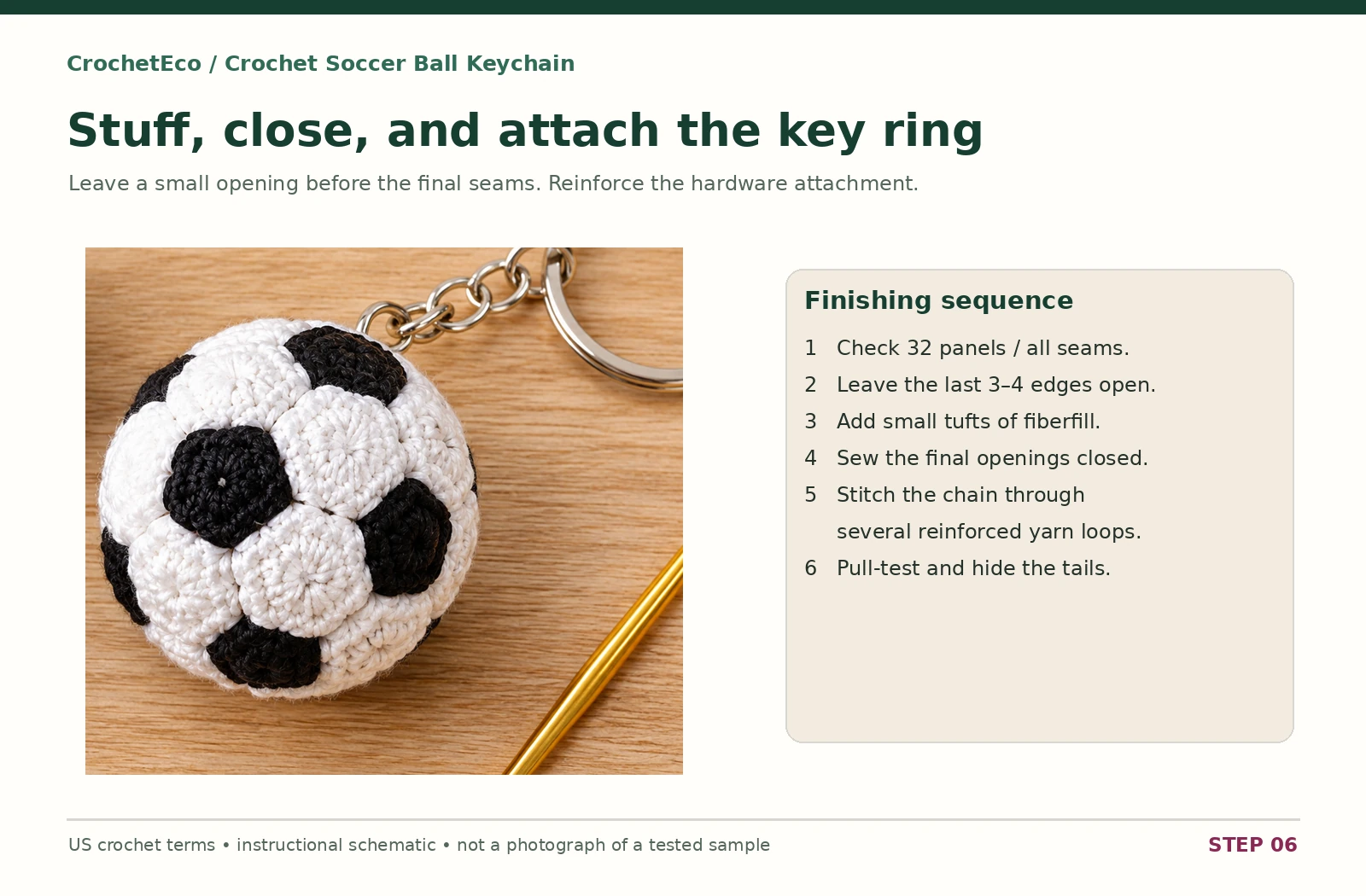
Each entry represents one shared four-stitch edge. The last sector wraps back to C1. Sew around the ball without twisting the panels. Stop with three or four edges still open.
Add small amounts of polyester stuffing through the opening. Push it gently toward the edges with the blunt end of a hook. The ball should feel rounded but not stretched. Sew the final seams, secure the ends inside, and roll the ball gently in your palms to even out its shape.
Step 7. Secure the split key ring
Choose a reinforced seam near a black-and-white junction at the top. Thread a short, strong loop through several sewn stitches, not through one loose strand. Connect that loop to a closed chain link and split key ring. Sew the loop back through the ball’s fabric several times. Hide the ends inside.
Troubleshooting and quick answers
| Problem | Check this first |
|---|---|
| The white hexagons seem too large | Compare one four-stitch side, not total stitch count. Both edge lengths should match. |
| Black patches meet | Stop sewing and check the half labels. Black panels should only touch white panels. |
| A hole appears at a corner | Join the corner loops with a small securing stitch without catching a fifth edge stitch. |
| The ball becomes lumpy | Check for one tight seam or too much stuffing. Ease the fiberfill toward the empty spots. |
| The finished ball is larger than expected | Use finer thread and a smaller compatible hook for your next sample; do not skip panels. |
Can I use worsted yarn?
Yes, but the result will be larger than a keychain made with fine thread. Keep both colors the same thickness and keep the four-stitch edge rule.
Can I make the ball with fewer than 32 pieces?
You can make a simpler stylized ball, but it will not follow the same traditional 12-pentagon, 20-hexagon layout. This tutorial teaches the full panel construction.
Do I need glue to join the motifs?
No. Stitch the edges with matching thread. Sewn seams are easier to inspect and repair.
How can I make the finished charm smaller?
Try finer cotton thread and a suitable smaller hook. First make one black and one white motif and measure their edges. A finished size cannot be promised without testing your gauge.
Save this free soccer ball pattern
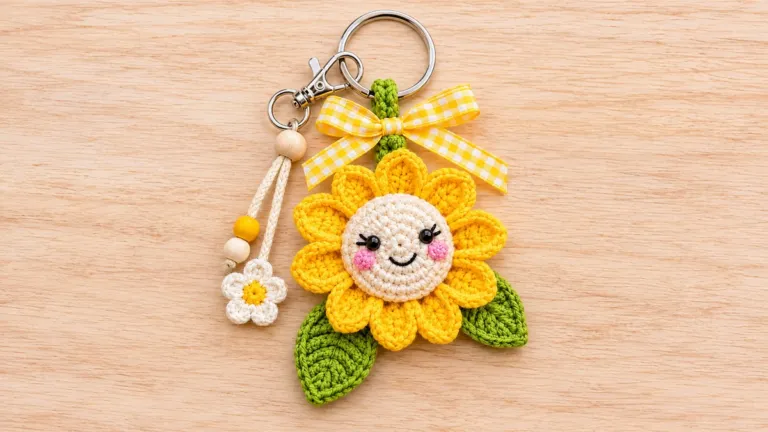
You can bookmark this crochet soccer ball keychain pattern and return to the numbered assembly maps whenever you need them. For another small gift project, see the CrochetEco sunflower keychain. Choose a matching thread size using the Craft Yarn Council yarn guide.
Editorial accuracy: The panel mathematics and seam relationships have been checked. The finished photograph is illustrative, and no physical sample has been crocheted or load-tested from these instructions. Test a sample and its key-ring attachment before describing the pattern as fully tested.

Comments
Leave a Comment