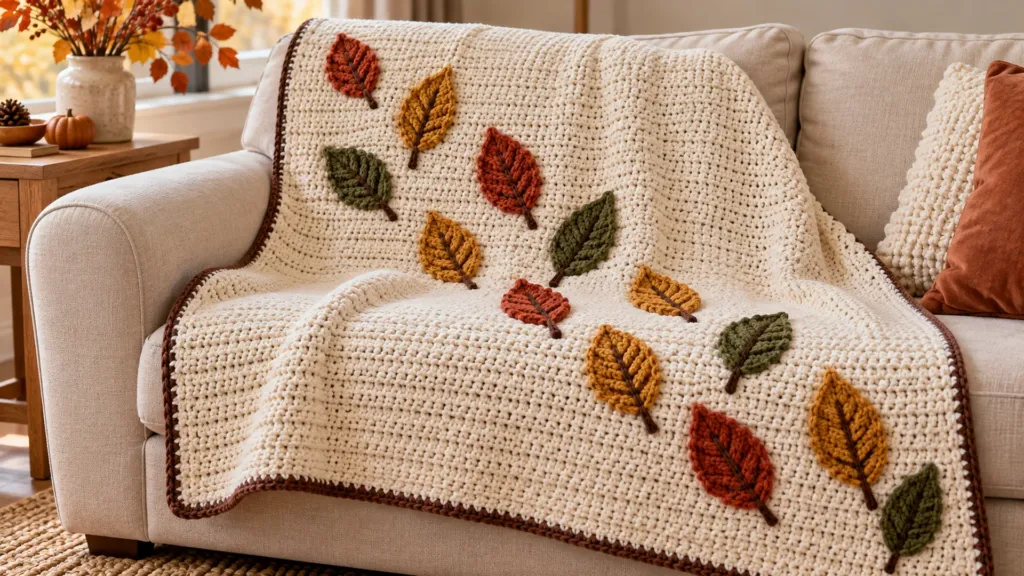
This free autumn leaves crochet blanket pattern pairs a soft oatmeal-colored throw with twelve sewn-on leaves in rust, mustard, and olive. The main blanket uses one easy half double crochet stitch. Each leaf is made separately, so you can place the fall colors where you like.
- Skill level: Confident beginner
- Finished size: About 36 × 48 in (91 × 122 cm), estimated
- Yarn: Medium/worsted (4), four colors plus border
- Hook: 5 mm (US H-8), or size for gauge
- Blanket: 120 stitches × 140 rows
- Leaves: 12 pointed leaf appliqués
Pattern status:
The stitch placement and counts have been checked mathematically. The size is an estimate, and no physical sample has been tested. The photographs show the intended appearance, not a verified handmade sample.
Jump to the pattern
- Materials and gauge
- Make the blanket
- Crochet each autumn leaf
- Arrange and sew on leaves
- Work the border
- Troubleshooting and FAQs
Materials and gauge
Choose a smooth, washable worsted-weight yarn. Use oatmeal or warm cream for the blanket, dark brown for the border and veins, and three leaf colors: burnt rust, golden mustard, and olive green.
- Worsted-weight yarn (4) in five colors
- 5 mm crochet hook, yarn needle, scissors, and stitch markers
- Measuring tape and optional blocking mats
The illustrative gauge is 14 half double crochet stitches and 12 rows per 4 in (10 cm). At that gauge, the body is about 34.3 × 46.7 inches before edging. Your finished size may be different.
For a yarn estimate, work a 20-stitch, 20-row swatch and weigh it. The main blanket contains 42 times as many worked stitches. Allow additional yarn for the border and leaves. Check the Craft Yarn Council yarn weight guide if your label is unclear.
US crochet abbreviations
ch = chain; sc = single crochet; hdc = half double crochet; dc = double crochet; tr = treble crochet; sl st = slip stitch; st = stitch.
Hdc: Yarn over, insert the hook, pull up a loop, yarn over, and pull through all three loops. A turning ch 2 never counts as a stitch here.
Autumn leaves crochet blanket: Make the throw
Foundation: With oatmeal yarn, ch 122.
Row 1: Hdc in the third chain from the hook and in every remaining chain. Turn. (120 hdc)
Rows 2–140: Ch 2, hdc in each of the 120 stitches. Turn after each row. (120 hdc per row)
Place stitch markers in the first and last stitch. Count after Rows 4, 20, and every 20 rows thereafter. Do not work into the turning chain. Fasten off after Row 140 and weave in the ends.
Fit check:
After Row 4, compare the width with your gauge swatch. Fix missing edge stitches now rather than after a long stretch of rows.
Crochet the twelve fall leaves
Make four leaves in each color. These are slender pointed leaves, not lobed maple or oak leaves. Crochet around both sides of a foundation chain, with the widest stitches near the middle. One leaf has 22 shaping stitches and a short chain stem.
Leaf pattern: First side and tip
Foundation: Ch 12 with a leaf color.
First side: Sc in second chain from hook, hdc in next chain, dc in next 2 chains, tr in next 2, dc in next 2, hdc in next, sc in next. (10 stitches across 10 chains)
Pointed tip: In the final unused foundation chain, work (sc, ch 2, sc). (2 sc and one ch-2 tip)
Return side and stem
Rotate the leaf, keeping the tip at the far end. Work into the unused loops on the opposite side, beginning with the chain beside the tip.
Work sc, hdc, dc in next 2 chains, tr in next 2, dc in next 2, hdc, sc. (10 stitches across 10 loops)
Sl st into the first sc at the base. Ch 5; sl st in the second chain from your hook and the next 3 chains. Sl st again at the leaf base. Fasten off, leaving a long tail for sewing. (22 shaping stitches; 4 stem slip stitches)
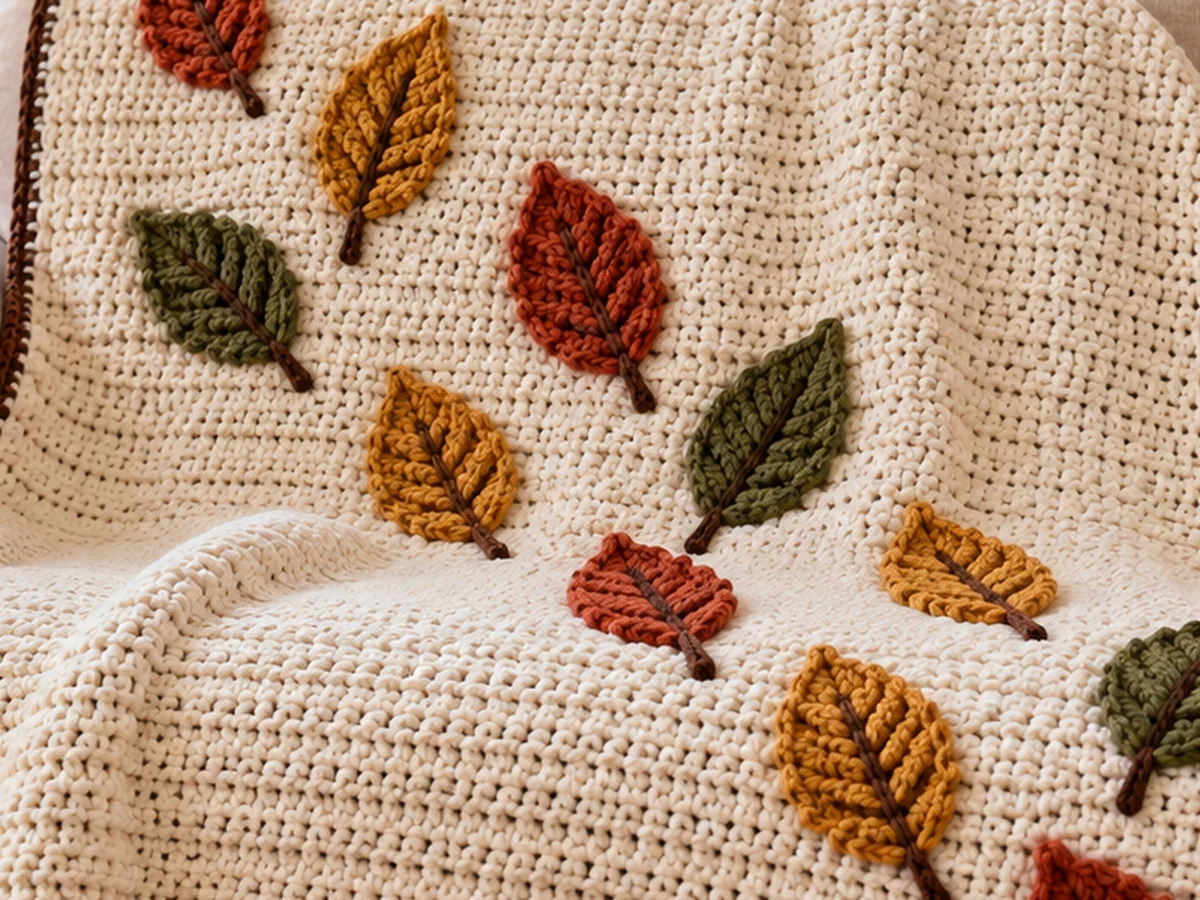
For a simple vein, use a needle and dark-brown yarn to stitch a short line down the middle of each leaf. Avoid pulling so tightly that it folds the fabric.
Arrange and sew the leaves
Lay the blanket flat. Arrange twelve leaves in a loose diagonal, using four of each color. Keep them several inches from the border. Rotate them slightly, but leave enough room to keep each leaf separate and easy to recognize.
Pin the leaves first. Sew around each leaf edge with a matching yarn tail, catching the blanket stitches without pulling them together. Secure each stem and vein. Weave ends through the wrong side in two directions. Check that no tips can lift or snag.
Use note:
This is a decorative throw for general home use. Sew every appliqué securely. Do not use a blanket with loose appliqués in an infant’s sleep space.
Add a neat brown border
Join dark-brown yarn at a corner. Work sc across the top and bottom, one stitch per blanket stitch. Along the sides, start with one sc per row end and adjust pickups evenly if the border pulls or ripples. Work 3 sc in each corner. Join with a sl st.
For a second round, work one sc in each stitch and 3 sc into the middle stitch of each corner group. Join and fasten off. The exact stitch count can vary if your side pickups need adjusting for your gauge.
Wash gently according to the yarn label and lay flat to shape. Check the leaves again once dry.
Troubleshooting and common questions
| Problem | What to check |
|---|---|
| The blanket narrows | Keep 120 hdc in each row; do not count ch 2. |
| The leaf looks uneven | Count 10 stitches on each side and 2 sc at the tip. |
| Leaf edges curl | Relax tension and block gently if the yarn permits. |
| The border waves | Reduce side pickups evenly. |
| The border pulls inward | Add a few side pickups evenly. |
Can I make the blanket smaller?
Yes. Choose a new body width from your measured gauge, chain two more than the desired hdc count, and work fewer rows. Reposition the leaves to suit.
Can I skip the leaf appliqués?
Yes. The oatmeal throw is complete without them. You can also sew on fewer leaves for a quieter look.
How do I make the leaves more secure?
Sew around the full outline, not just the stem. Keep the stitches loose enough that the blanket stays flat.
Save this free fall blanket pattern
Keep the stitch counts handy as you work. For more autumn shapes, see our crochet fall leaf garland. New crocheters can use our beginner stitch guide and hook size chart.
Editorial note: This original pattern is a calculated draft. The illustrative images were digitally generated and should not replace testing a real sample for size, stitch behavior, and leaf attachment.
Comments
Leave a Comment