
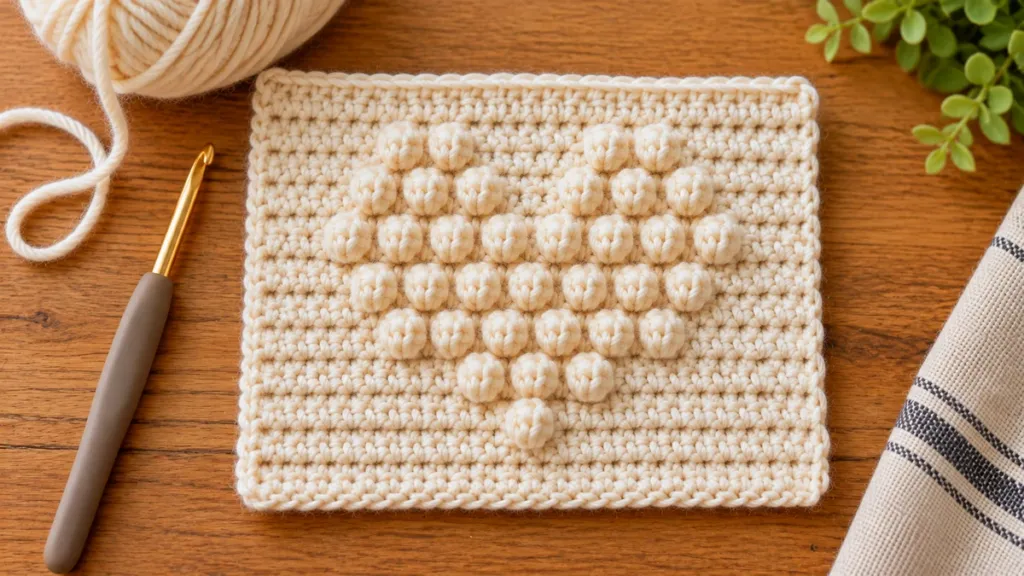
Turn a simple grid into raised crochet pixel art
Learn the bobble rule, read a small chart, and make a textured heart without losing your stitch count.
The crochet tapestry bobble stitch is a simple way to turn a pixel-style chart into raised crochet texture. Instead of changing the whole fabric shape, you use bobbles as the filled pixels and plain single crochet as the empty spaces.
The easiest way to learn it is with a small chart. In this tutorial, every chart square uses two stitches and every picture row uses two crochet rows. That keeps the math easy and gives each bobble enough space to stand out.
1. What Is the Crochet Tapestry Bobble Stitch?
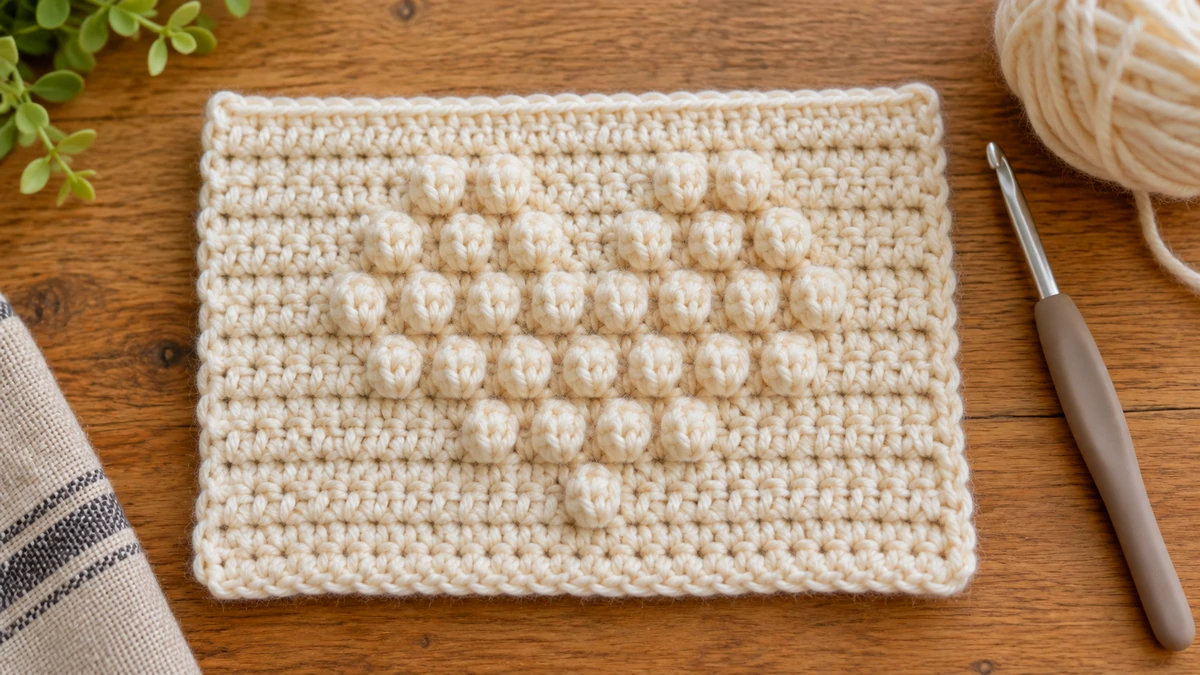
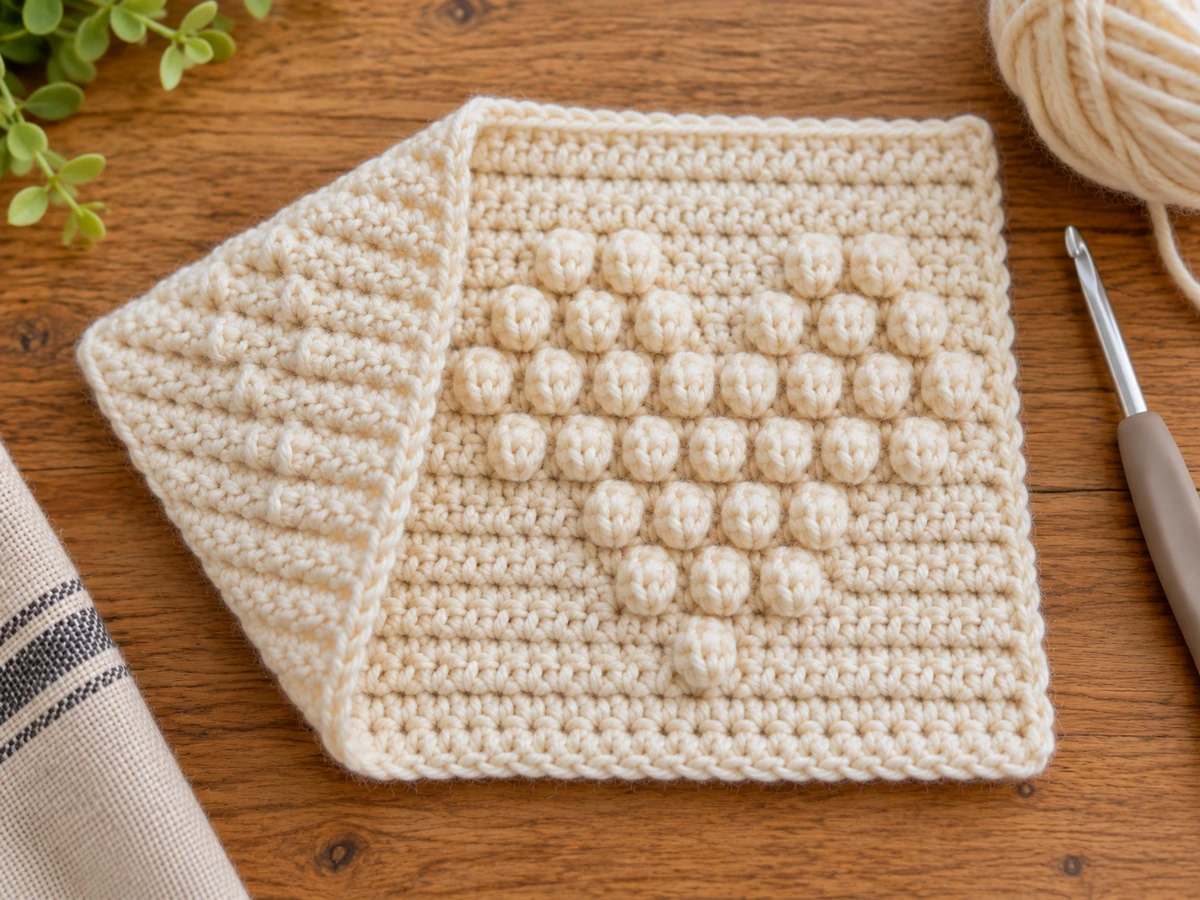
The crochet tapestry bobble stitch turns small raised bobbles into picture pixels. A plain stitch is an empty chart square. A bobble is a filled chart square.
When several bobbles are placed in planned positions, they can form a heart, flower, letter, fruit, animal, or almost any simple pixel design.
The useful part is that the whole piece can still be worked in ordinary back-and-forth rows. You do not need a special hook, and you do not need to change the stitch count every time the picture changes.
A bobble naturally pushes away from the side where you make it. For this tutorial, all bobble rows are worked with the wrong side facing you so the raised texture pops out on the right side of the finished piece.
2. Bobble Tapestry vs. Traditional Tapestry Crochet
These names can be confusing. Traditional tapestry crochet normally creates pictures with color changes. The unused yarn may be carried inside the stitches while another color is being used.
A crochet tapestry bobble stitch project can work differently. The picture can come from texture alone. In the sample below, the heart is made with raised bobbles in the same yarn as the background, so you can learn the chart system without adding color changes at the same time.
Learn the bobble chart in one color before adding a second color. That makes it much easier to see whether a problem comes from the stitch count or from the color change.
3. Crochet Tapestry Bobble Stitch Materials
Smooth #4 Medium / worsted yarn. A light color makes the bobbles easier to see.
5.0 mm (H-8) for the sample. Change size if your yarn needs a different hook.
One removable marker to identify the right side of the fabric.
Scissors and a yarn needle for weaving in the two yarn ends.
If hook sizes are still confusing, the CrochetEco crochet hook size chart explains the common US and metric sizes.
For standard US crochet abbreviations, you can also check the Craft Yarn Council crochet abbreviation list .
4. US Crochet Terms and the 5-dc Bobble
ch = chain · sc = single crochet · dc = double crochet · bo = bobble · st / sts = stitch / stitches · yo = yarn over · RS = right side · WS = wrong side · rep = repeat · FO = fasten off
This crochet tapestry bobble stitch tutorial uses one specific bobble throughout: a five-double-crochet bobble worked into one stitch.
5-dc Bobble — bo
Step 1: Yo, insert the hook into the indicated stitch, yo and pull up a loop.
Step 2: Yo and pull through the first 2 loops. Do not finish the double crochet.
Step 3: Repeat Steps 1 and 2 four more times in the same stitch.
Checkpoint: You now have 6 loops on the hook: the original loop plus five unfinished double crochets.
Step 4: Yo and pull through all 6 loops. The bobble is complete.
Do not add a chain for this tutorial. The single crochet in the next stitch helps lock the bobble in place.
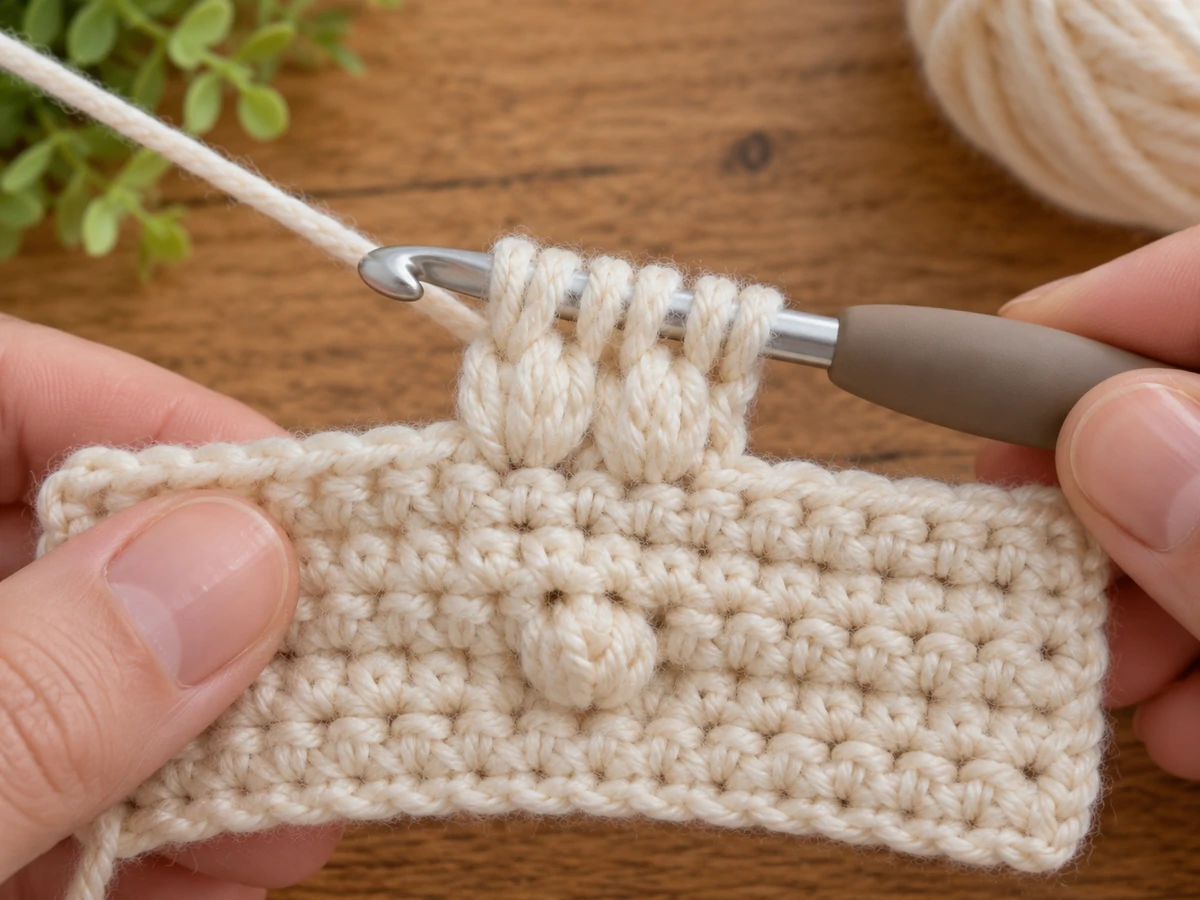
That is normal. You are looking at the wrong side. After the next single crochet, gently push the bobble away from you. It should round out on the right side.
5. The Two-Stitch Pixel Rule
This is the part that makes the crochet tapestry bobble stitch easy to chart.
Every square on the heart chart represents two crochet stitches.
Work 1 bobble in the next stitch, then 1 sc in the next stitch.
Work 1 sc in each of the next 2 stitches.
Our chart is 11 squares wide:
11 pixels × 2 stitches = 22 stitches.
That number never changes. A bobble replaces one ordinary single crochet; it does not add a new stitch.
Each picture row also uses two crochet rows: one WS motif row containing the bobbles, then one RS row of plain single crochet.
Chart width × 2 = crochet stitch count. A 20-pixel-wide chart would need 40 stitches with this method.
6. Free Crochet Tapestry Bobble Stitch Heart Chart
The chart below is shown the way the finished heart looks, with the top at the top. Crochet starts at Row 1 at the bottom and moves upward.
11 × 8 Bobble Heart Chart
Pink X = bobble + sc • Pale square = 2 sc
The heart is symmetrical, so you do not have to worry about reversing the chart direction while learning. For an asymmetrical picture, remember that back-and-forth crochet changes direction on every row.
7. Crochet Tapestry Bobble Stitch Heart Tutorial
This mini heart is a practice swatch for the crochet tapestry bobble stitch. The written instructions below match the chart exactly.
Foundation and Base Row
Ch 23.
Sc in the 2nd ch from the hook and in every remaining chain. (22 sts) Place a removable marker on the side facing you. This is the right side. Turn.
Motif Row 1 — Bottom Point
Ch 1, does not count as a stitch. Sc in next 10 sts, bo in next st, sc in next st, sc in final 10 sts. (22 sts) Turn.
Ch 1, sc in every stitch across. (22 sts) Turn.
Motif Row 2
Ch 1. Sc in next 8 sts, [bo in next st, sc in next st] 3 times, sc in final 8 sts. (22 sts) Turn.
Ch 1, sc in every stitch across. (22 sts) Turn.
Motif Row 3
Ch 1. Sc in next 6 sts, [bo in next st, sc in next st] 5 times, sc in final 6 sts. (22 sts) Turn.
Ch 1, sc in every stitch across. (22 sts) Turn.
Motif Row 4
Ch 1. Sc in next 4 sts, [bo in next st, sc in next st] 7 times, sc in final 4 sts. (22 sts) Turn.
Ch 1, sc in every stitch across. (22 sts) Turn.
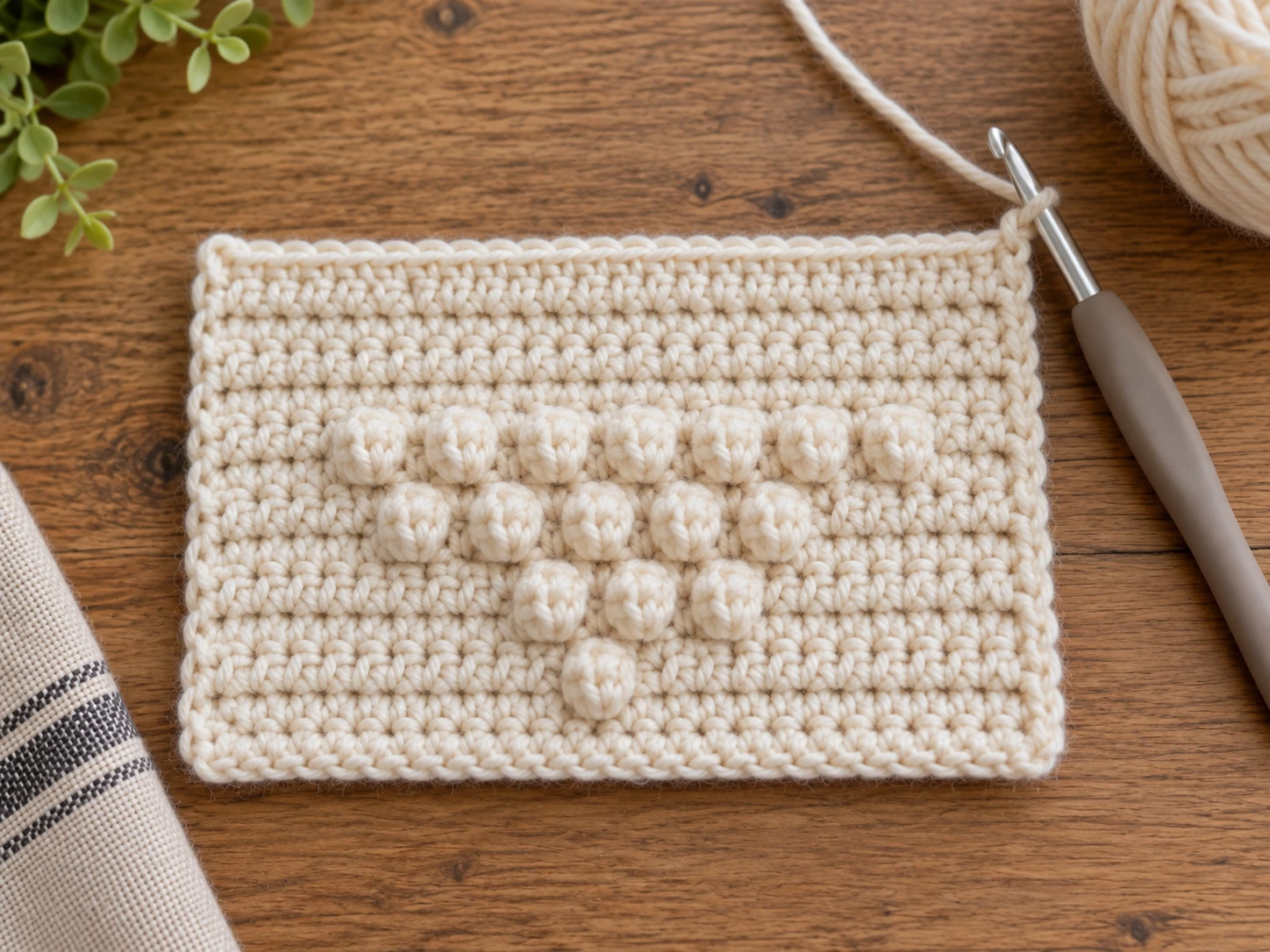
Motif Row 5
Ch 1. Sc in next 2 sts, [bo in next st, sc in next st] 9 times, sc in final 2 sts. (22 sts) Turn.
Ch 1, sc in every stitch across. (22 sts) Turn.
Motif Row 6 — Widest Row
Ch 1. [Bo in next st, sc in next st] 11 times. (22 sts) Turn.
Ch 1, sc in every stitch across. (22 sts) Turn.
Motif Row 7 — Split the Heart
Ch 1. [Bo in next st, sc in next st] 5 times, sc in next 2 sts, [bo in next st, sc in next st] 5 times. (22 sts) Turn.
Ch 1, sc in every stitch across. (22 sts) Turn.
Motif Row 8 — Top Lobes
Ch 1. Sc in next 2 sts, [bo in next st, sc in next st] 3 times, sc in next 6 sts, [bo in next st, sc in next st] 3 times, sc in final 2 sts. (22 sts) Turn.
Ch 1, sc in every stitch across. (22 sts) FO.
Every row finishes with 22 stitches. The number of bobbles changes the picture, but it never changes the width of the fabric.
| Motif row | Bobble count | Total stitches |
|---|---|---|
| Row 1 | 1 bobble | 22 |
| Row 2 | 3 bobbles | 22 |
| Row 3 | 5 bobbles | 22 |
| Row 4 | 7 bobbles | 22 |
| Row 5 | 9 bobbles | 22 |
| Row 6 | 11 bobbles | 22 |
| Row 7 | 10 bobbles | 22 |
| Row 8 | 6 bobbles | 22 |
8. How to Turn Your Own Pixel Chart Into Crochet
Once the heart makes sense, you can use the same crochet tapestry bobble stitch rule with another small grid.
Start with a simple black-and-white pixel picture. Count the number of squares across, then multiply that number by two.
15 chart squares × 2 stitches = 30 crochet stitches. Your foundation chain would be 31 if you work the first single crochet into the second chain from the hook.
Then use one WS motif row for every chart row, followed by one plain RS single crochet row.
For a first design, keep the picture under about 20 pixels wide. Large charts work too, but they take more yarn and make counting mistakes harder to spot.
What about color?
After you are comfortable with the one-color version, you can make the bobbles in a contrast color and keep the background in another color.
That adds true colorwork to the texture, but the stitch math stays the same: one filled pixel still occupies two stitches and one blank pixel still occupies two stitches.
9. Common Crochet Tapestry Bobble Stitch Problems
My bobbles are showing on the back.
You probably worked the motif row with the right side facing you. Keep the removable marker on the right side and make every bobble row while the marker is facing away from you.
My stitch count keeps growing.
A bobble counts as one stitch. Do not work another single crochet into the same stitch after the bobble. Move to the next stitch for the single crochet that completes the filled pixel.
My heart is leaning to one side.
Count the plain single crochets before and after the bobble section. One missing background stitch is enough to move the whole picture sideways.
My bobbles look flat.
Make sure all five unfinished double crochets go into the same stitch. Close all six loops together, then work the next single crochet firmly. You can also gently push the finished bobble toward the right side.
The swatch is curling.
Bobbles place a lot of yarn into small areas, so a little waviness is normal. Keep your single crochet tension relaxed and block the finished swatch gently. If your fabric is strongly curling, a slightly larger hook can help.
For more help with curved or wavy fabric, see why crochet curls and how to fix it .
10. Bobble vs. Puff vs. Popcorn Stitch
These stitches can look similar in photos, but they are not made the same way.
| Stitch | How it is made | Texture |
|---|---|---|
| Bobble | Several unfinished dc stitches are worked into one stitch and closed together. | Firm, rounded raised bump. |
| Puff | Several elongated loops are drawn up into one stitch and closed together. | Softer and usually more flexible. |
| Popcorn | Several complete stitches are made first, then joined together. | Very pronounced rounded texture. |
For this tutorial, stay with the written 5-dc bobble. Changing to a puff or popcorn stitch will change the height and shape of the pixels.
11. Crochet Tapestry Bobble Stitch FAQ
Is the crochet tapestry bobble stitch beginner friendly?
Yes, once you know chain, single crochet, double crochet, and how to turn rows. The hardest part is usually reading the chart, not making the stitch.
Why does each pixel use two stitches?
It gives every bobble one plain single crochet beside it. This keeps the bobbles separated and makes the picture easier to read. It also makes the stitch count simple: chart width multiplied by two.
Do I need two yarn colors?
No. A one-color bobble tapestry uses texture to create the picture. Two colors are optional and can be added after you are comfortable with the basic chart method.
Can I use cotton yarn?
Yes. Smooth cotton shows bobble definition very clearly. Smooth acrylic or wool can also work. Avoid very fuzzy yarn when learning because it makes the stitch structure harder to see.
Can I make a larger picture?
Yes. Multiply the chart width by two to get the stitch count. Use one motif row plus one plain return row for each chart row, and keep checking the count after every row.
Final Thoughts on the Crochet Tapestry Bobble Stitch
The crochet tapestry bobble stitch becomes much easier once you stop thinking of the picture as a complicated crochet pattern and start seeing it as a simple grid.
One filled pixel is a bobble plus one single crochet. One empty pixel is two single crochets. The heart above always stays at 22 stitches, even though the number of bobbles changes from row to row.
If you are still learning the basic stitches, start with the CrochetEco beginner crochet guide before trying the chart.
Learn Another Crochet Technique
Clear tutorials, useful stitch guides, and practical help for your next project.
Browse Crochet Tutorials →

Reader discussion
Reader Comments
Tried this pattern? Share what worked, ask a question, or help another crocheter.
Your turn
Comments are moderated to keep the discussion useful and family-friendly. Please do not post personal information.